Part of our Shopify Store Management guide. Spoke 10 of 10.
Every Shopify store eventually reaches the same point. The founder who used to handle everything no longer has time. Theme updates wait. The app audit never happens. A developer fixes one thing and nobody knows who to call for the next. Somebody needs to own store management properly, and the question becomes who.
There are three main answers: hire someone in-house, work with a freelancer, or retain an agency. Each can work well. Each can also go badly, usually because the model doesn't match the store's actual workload.
This guide compares the three models honestly, using 2026 cost data, and gives you a simple way to decide. We're an agency ourselves, so we'll be upfront: a retainer isn't always the right answer, and we'll tell you when it isn't.
Key Takeaways
- A US Shopify developer earns about $110,000 a year on average in 2026. With benefits, which average 30% of employer compensation costs, the full cost is considerably higher.
- Upwork lists a global median of $20 an hour for Shopify developers, but US-based freelancers typically charge far more, and rates vary widely with experience.
- Agency retainers for ongoing support commonly range from about $1,000 to $10,000 a month, depending on the agency's tier and scope.
- Retainers usually start to beat ad-hoc hourly work at around 15 to 20 hours of monthly Shopify work. Below that, lighter models often make more sense.
What Are Your Options for Shopify Store Support?
There are four common ways to staff Shopify store management: owner-led, where the founder handles most work with occasional outside help; an in-house developer on your payroll; a freelancer paid per task or hour; and an agency retainer, where you pay a monthly fee for a team with a defined scope. Many growing stores combine two of them.
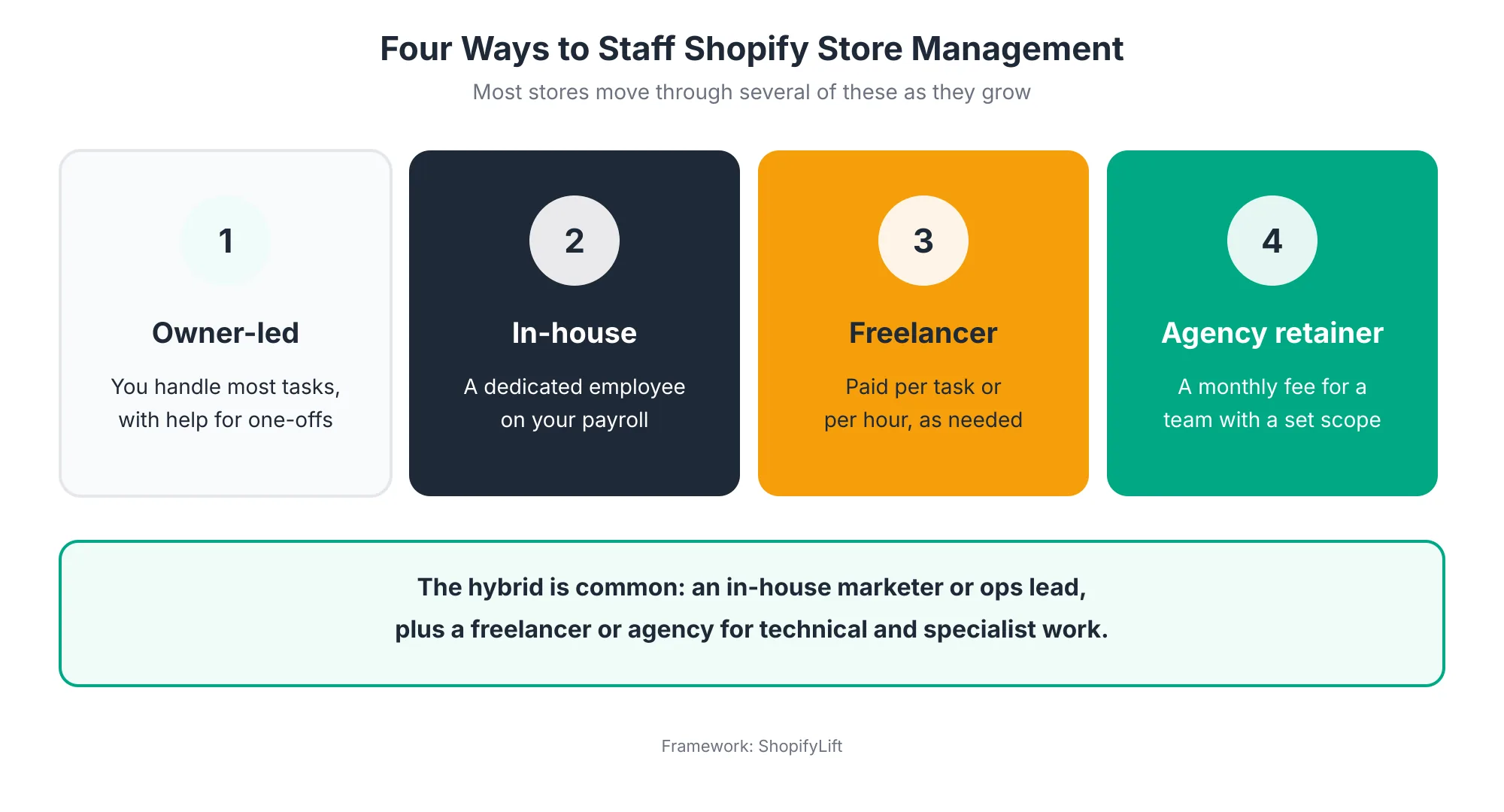
- Owner-led. The founder or an operations lead does routine work, using a freelancer for occasional technical tasks. It's the cheapest option and works well early on, until the owner's time becomes the bottleneck.
- In-house developer. A dedicated employee who knows your store deeply and is available every day. Best for stores with steady, full-time development work.
- Freelancer. An independent specialist paid by the hour or project. Flexible and often cost-effective for defined tasks, with less continuity.
- Agency retainer. A monthly agreement covering maintenance, fixes, and improvements, delivered by a team. StoreBuilt describes a Shopify support retainer as an agreed monthly model covering theme work, bug fixes, app changes, CRO improvements, SEO checks, analytics QA, and release support StoreBuilt.
The right choice depends less on which model is "best" and more on how much work your store generates, what skills that work needs, and how much management time you can give it.
What Does Each Support Model Cost in 2026?
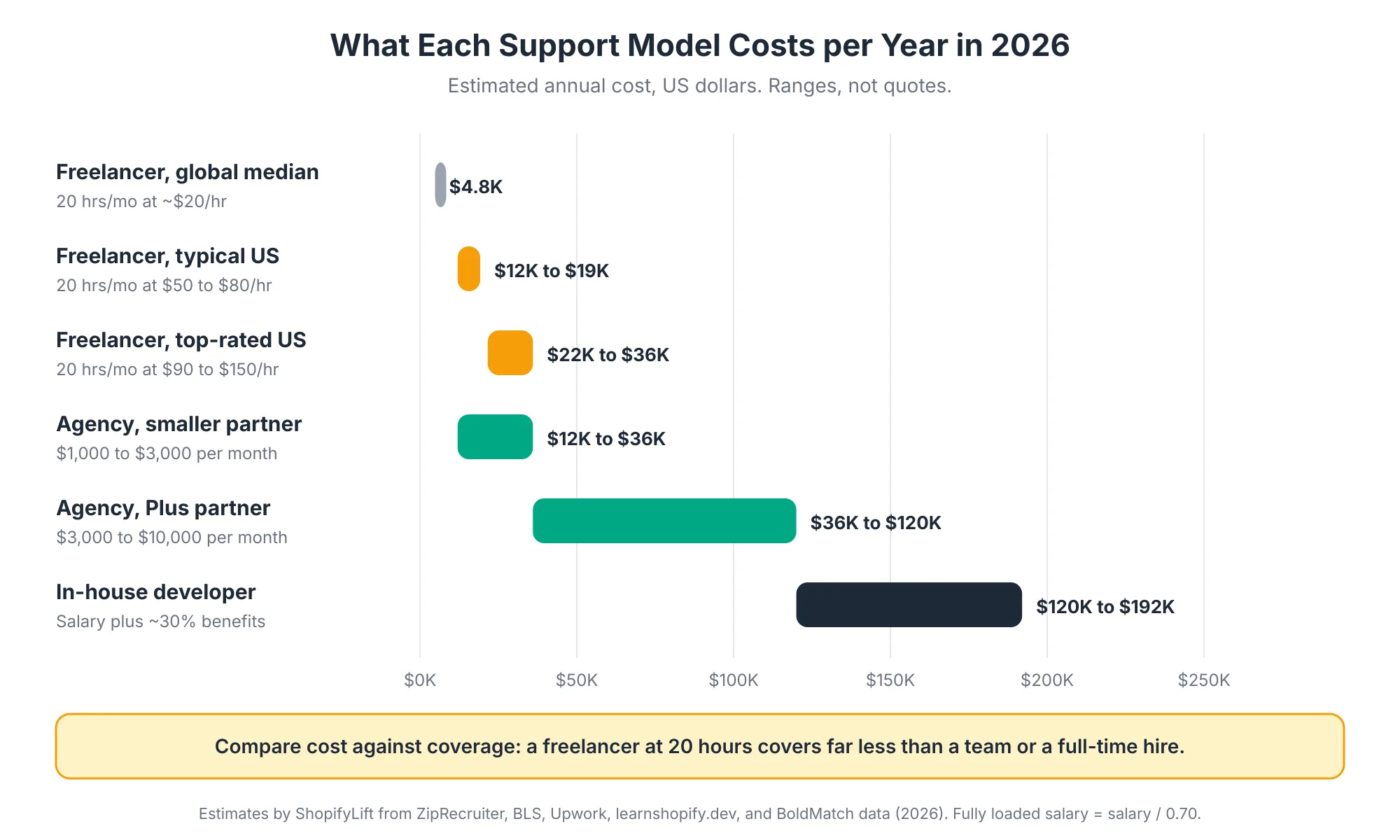
In 2026, a US Shopify developer earns about $110,000 a year on average, before benefits. Freelance rates range from a $20 global median on Upwork to well over $100 an hour for top-rated US specialists. Agency retainers commonly run from about $1,000 a month at smaller partner agencies to $10,000 or more at larger ones.
In-House Developer
ZipRecruiter puts the average annual pay for a US Shopify developer at $109,905 as of August 2026, with most salaries between $84,000 at the 25th percentile and $134,500 at the 75th ZipRecruiter. Salary.com reports a similar average of $111,560, or about $54 an hour Salary.com.
Salary isn't the full cost, though. According to the Bureau of Labor Statistics, benefits accounted for 30% of private industry employer compensation costs in June 2026, with wages making up the other 70% BLS. Using that ratio, a developer on the middle range of salaries costs roughly $120,000 to $192,000 a year once benefits are included. That's before recruitment, equipment, software, and management time.
Freelancer
Freelance rates vary enormously. Upwork lists a median of $20 an hour for Shopify developers, with typical rates between $15 and $29 Upwork. Its experience-based figures reach around $95 an hour for experts Abbacus Technologies.
That global median includes a lot of entry-level and offshore work. Filtered to US-based freelancers, the median rises to roughly $50 to $80 an hour, with top-rated US developers charging about $90 to $150 learnshopify.dev. At 20 hours a month, that's roughly $12,000 to $36,000 a year for US talent.
The hourly rate isn't the whole story. You're also paying for the time it takes you to brief, review, and manage the work, and for the gaps when your freelancer is busy with other clients.
Agency Retainer
Retainer pricing depends heavily on the agency's size and tier. One 2026 pricing guide puts ongoing support retainers at smaller Shopify partner agencies at around $1,000 to $3,000 a month, and at Plus partner agencies at around $3,000 to $10,000 BoldMatch. Another agency cites retainers of $4,000 to $12,500 or more a month for comprehensive support Charle. In the UK, mid-tier retainers typically run from £1,500 to £5,000 a month Grumspot.
For a sense of scale, one agency estimates that a mid-market brand on Shopify's Advanced plan with $2 million to $5 million in revenue might spend $12,000 to $24,000 a year on an agency retainer Shero Commerce.
Be careful comparing prices alone. One agency points out that "full Shopify management" priced at $800 to $1,500 a month usually means reactive support, buying one to two hours of work a week BoltRamp. That can be exactly right for a small store. It just isn't the same service as a proactive retainer with a team behind it.
How Do the Models Compare Beyond Price?
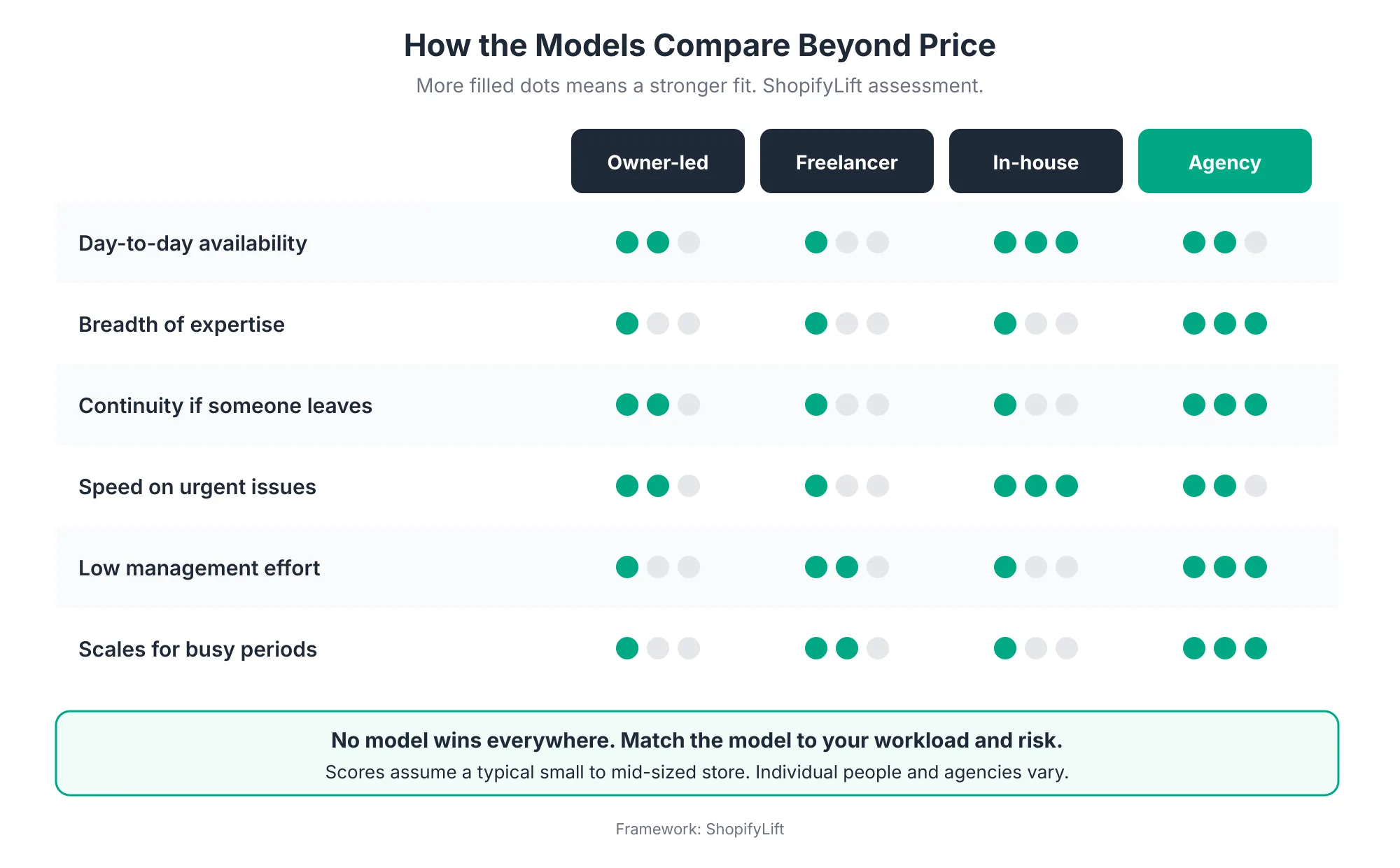
Beyond price, the models differ in availability, breadth of expertise, continuity when people leave, speed on urgent issues, how much of your time they need, and how easily they scale for busy periods. In-house staff are the most available. Agencies offer the broadest expertise and continuity. Freelancers offer flexibility. No model wins on every factor.
In-House: Deep Knowledge, Narrow Skills
An in-house developer knows your store better than anyone and can respond in minutes during working hours. The limits are breadth and resilience. Shopify store management spans theme code, apps, performance, analytics, merchandising, security, and platform changes. One person rarely covers all of that equally well. And when they're on holiday, sick, or leave, much of their knowledge goes with them.
Freelancer: Flexible, but Thin
A good freelancer can deliver excellent work at a fair price, especially for clearly defined tasks. The challenges are availability and continuity. Your urgent problem may land during their busiest week with another client. There's rarely anyone accountable for proactive maintenance between projects, and if they move on, you start again with someone new.
Agency Retainer: Breadth and Continuity, Less Intimacy
A retainer gives you a team rather than a person: developers, and often specialists in performance, CRO, or SEO. The agency already knows your theme structure, app stack, approval process, and history Grumspot. If one person leaves, the account continues. The trade-off is that you aren't anyone's only client, and response times depend on the agreement.
Owner-Led: Low Cost, With Hidden Limits
Doing it yourself costs nothing in fees. The real cost is your time and the tasks that quietly don't get done. Owner-led management works well for small, simple stores. It becomes expensive when the owner's time is better spent on growth, or when technical tasks keep slipping.
Which Support Model Fits Your Store?
Match the model to your monthly workload. With under about 10 hours of Shopify work a month, owner-led management plus a freelancer usually works best. From roughly 15 to 40 hours, or when you need several skills, an agency retainer usually fits. With full-time development work every week, hire in-house and add a retainer or specialists for the gaps.
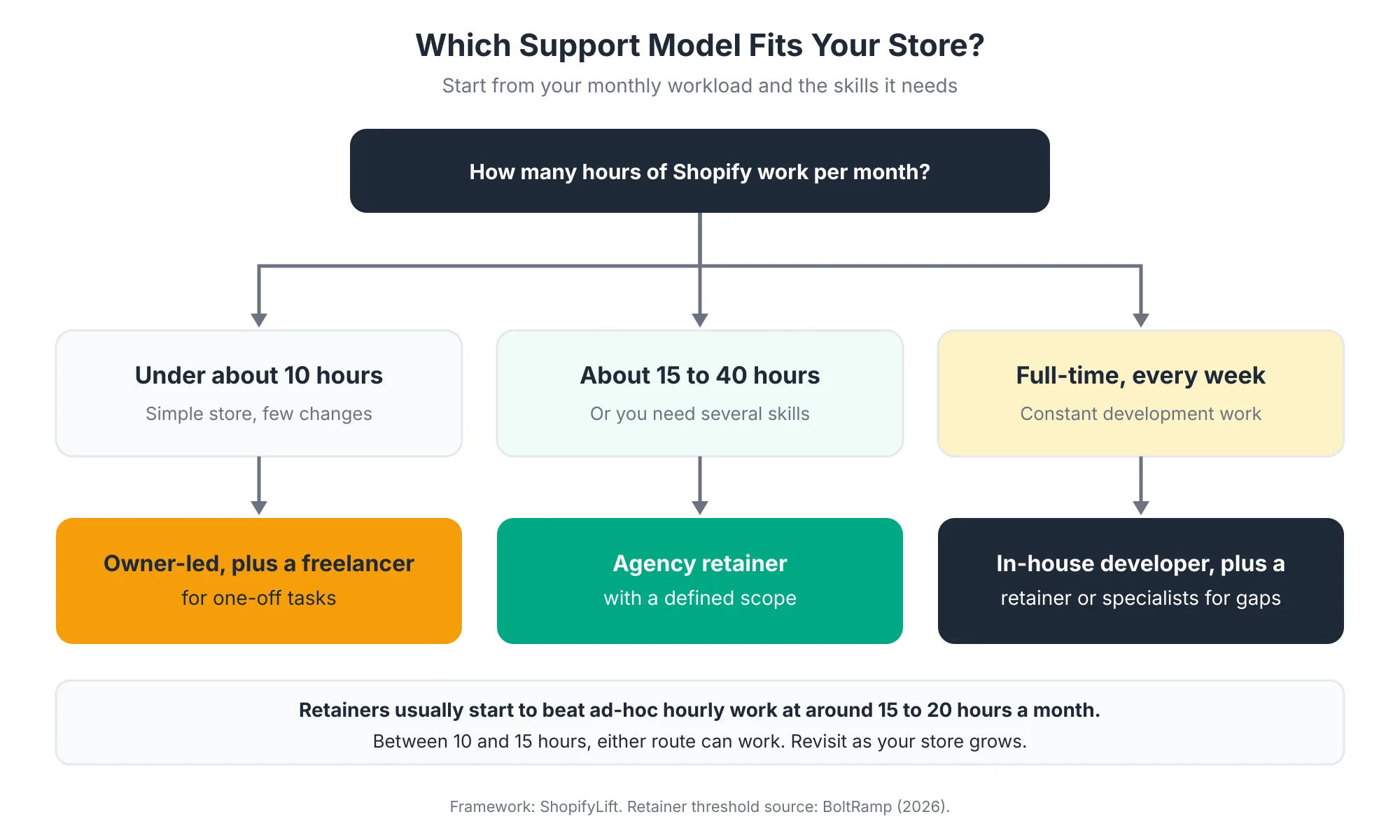
The workload threshold matters because of how pricing works. One agency puts the tipping point clearly: retainers become favorable at roughly 15 to 20 hours of monthly Shopify work BoltRamp. Below that, you're often paying for capacity you don't use. Above it, ad-hoc hourly work gets expensive and slow, because every request starts with a briefing and a quote.
Workload isn't the only factor, though. Consider these too:
- How often your store changes. A retainer works best when a store is active every week, with regular merchandising updates, campaign pages, app evaluations, and testing Grumspot. A store that changes a few times a year needs less.
- How many skills you need. If your work spans theme development, performance, analytics, and integrations, one freelancer or one employee is unlikely to cover it all well.
- How risky downtime is. If an hour of broken checkout costs you thousands, response times and backup cover matter more than hourly rates.
- How much management time you have. Freelancers and junior hires need more direction. Agencies typically need less day to day, but still need a clear owner on your side.
How Should You Estimate Your Monthly Shopify Workload?
Estimate your workload by adding four types of work: routine maintenance, merchandising and content, fixes and small changes, and improvement projects. For a typical mid-sized store, that totals roughly 22 to 52 hours a month, with peak season months often doubling it. Your own numbers will differ, so track a few weeks of actual requests.
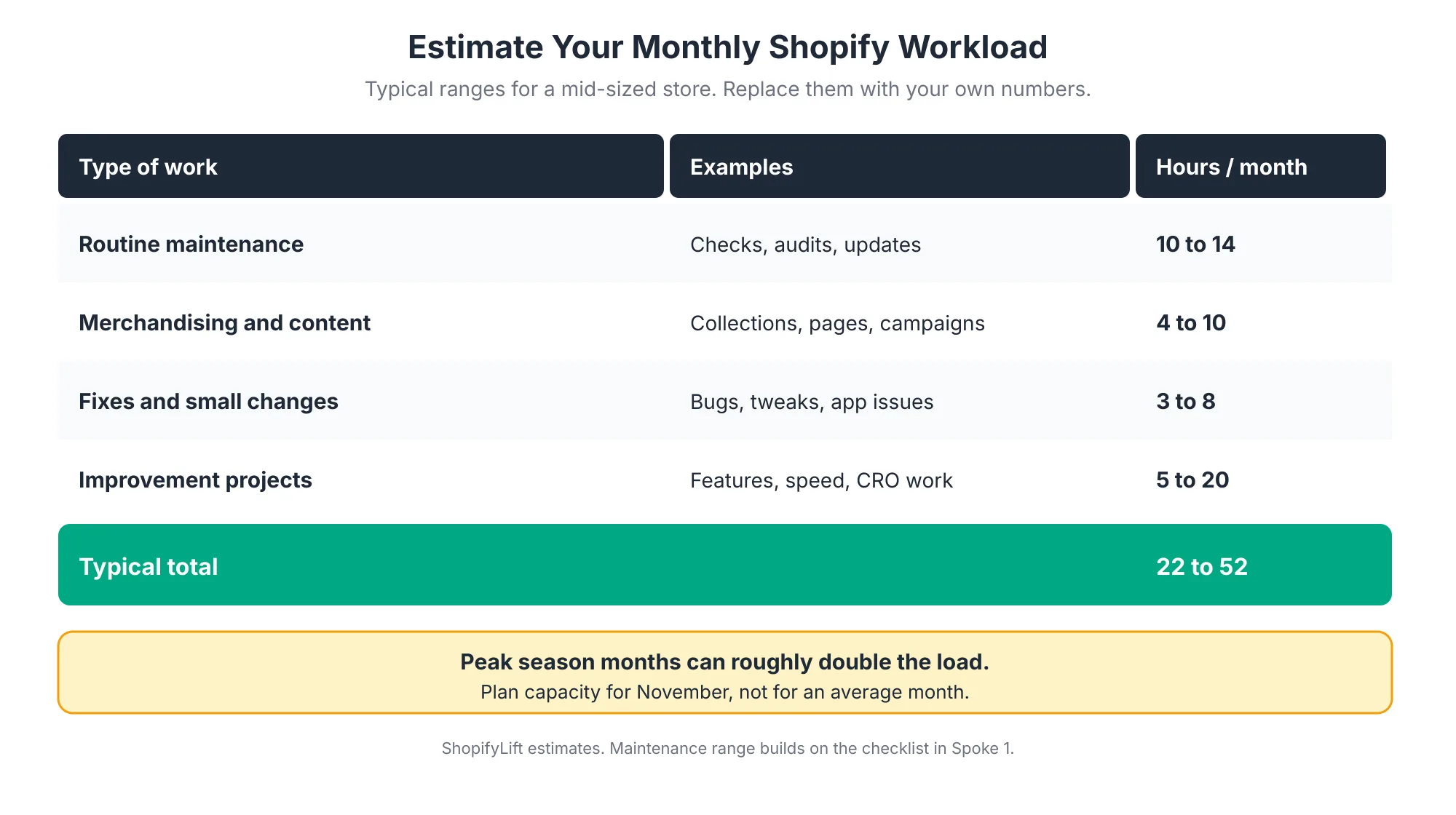
These ranges are our own estimates for a mid-sized store, and they're a starting point rather than a benchmark. The routine maintenance figure builds on the cadence in The Shopify Store Maintenance Checklist, which covers weekly checks, monthly audits, quarterly reviews, and twice-yearly deep reviews.
The best way to get your real number is to measure it. For four weeks, log every Shopify task your team does or wants done, with a rough time estimate. Include the things that got postponed. Many stores discover their actual workload is higher than they thought, because the backlog of undone work never showed up anywhere.
Plan capacity for your busiest months, not your average ones. Peak season brings campaign builds, offer testing, code freezes, and monitoring on top of normal work. We cover that in Seasonal Store Readiness.
Not sure how much support your store needs?
Our free Shopify Store Health Audit estimates your maintenance workload and backlog, and recommends the support model that fits, whether or not that's us. Request your free audit
What Should a Good Shopify Retainer Include?
A good Shopify retainer includes a clear scope, defined response times, a predictable monthly fee, proactive maintenance rather than only reactive fixes, regular reporting, and clean exit terms. It should leave your store stronger each quarter, not just less broken, and it should make clear who owns your accounts, code, and documentation.
Scope
A retainer's scope should be written down. StoreBuilt's guide lists what a retainer may cover: theme changes, bug fixes, app configuration, analytics QA, SEO checks, CRO improvements, landing page support, speed reviews, content updates, and launch support StoreBuilt. You won't need all of these, but you should know which ones are included.
Proactive Work
The difference between a good retainer and an expensive help desk is proactive work. Grumspot argues that a retainer should leave your store stronger every quarter than it was at the start, not just less broken Grumspot. Look for scheduled maintenance, regular app and speed reviews, and a plan for improvements, not only a queue of tickets.
A Healthy Pricing Model
Hours-based retainers are common and can work well. Watch for the behavioral trap, though. If a retainer makes everyone obsess over timesheets, it usually underperforms Grumspot. Clear priorities and trust work better than arguing about whether a meeting used up hours.
Reporting and Ownership
Expect a short monthly report: what was done, what's planned, any risks found, and how key metrics moved. Also confirm that you own everything: your Shopify account, your theme code, your app accounts, and the documentation. You should be able to change partners without losing anything.
Knowing When Maintenance Is Not Enough
A good partner will also tell you when a retainer can't solve your problem. StoreBuilt recommends moving beyond maintenance when the theme, platform, data model, or app stack prevents safe improvement StoreBuilt. At that point, a rebuild or migration may be the better investment. Our Shopify development services can help you make that decision.
What Questions Should You Ask Before Hiring Shopify Support?
Ask every option the same questions: relevant Shopify experience, who does the work, response times, what happens to unused hours, how changes are tested, whether they use version control, how access is handled, what reporting looks like, who owns accounts and code, and how to end the arrangement. Comparing the answers side by side makes the decision much clearer.
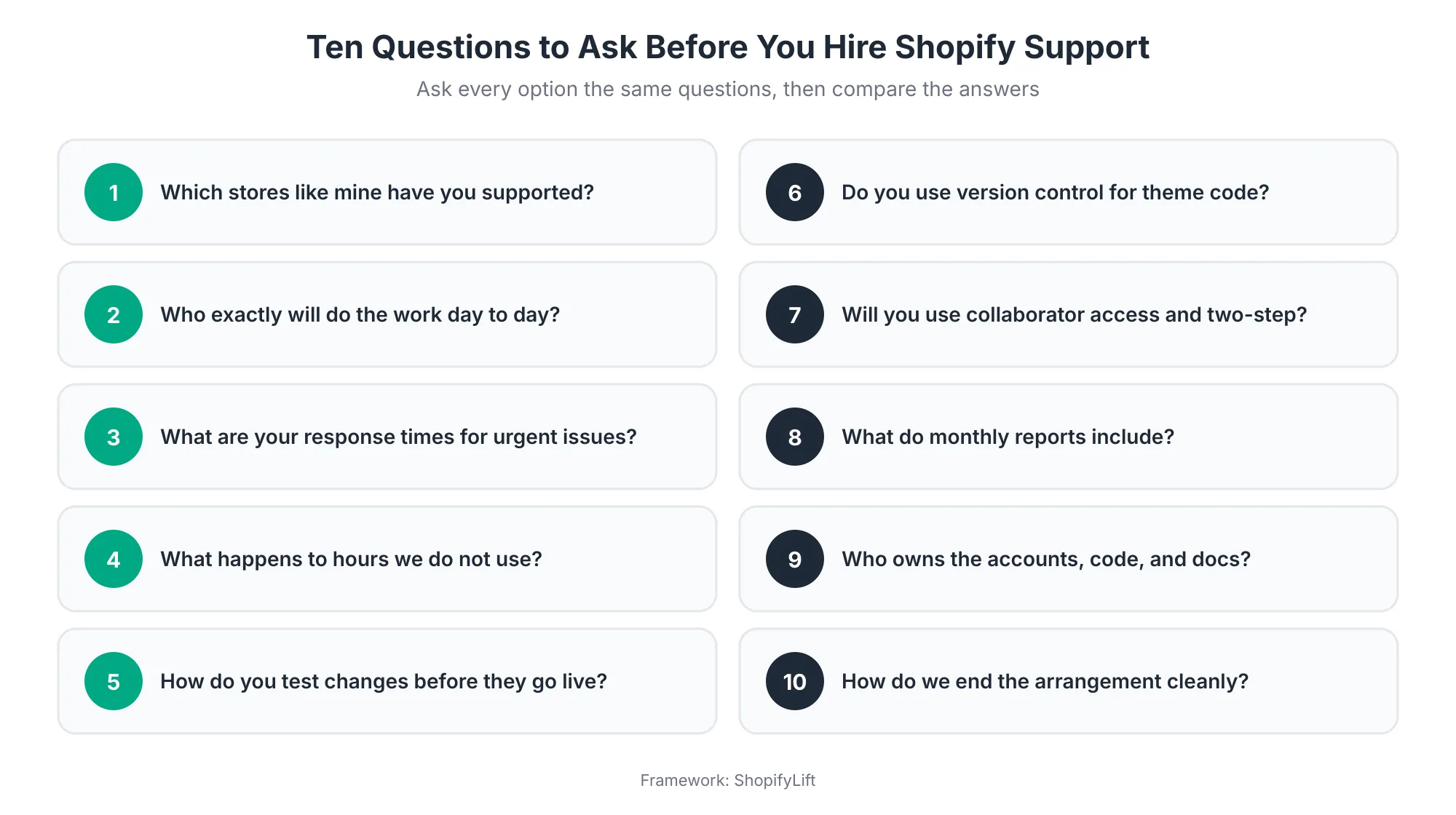
A few of these deserve extra attention:
- Who exactly does the work? With agencies, the person who sells the retainer is often not the person who does the work. Ask to meet the people who'll actually touch your store.
- How are changes tested? Good partners work on duplicate themes, test on mobile, and publish during quiet windows. Our theme update guide describes what safe practice looks like.
- Do you use version control? A partner who keeps your theme in Git leaves you with a full history of every change, which makes handovers and rollbacks far easier.
- How do we end it? Ask what happens to your code, documentation, and access if you part ways. A confident partner will have a clear, fair answer.
How Do You Keep Control When Working With Outside Partners?
Keep control by giving outside partners collaborator access rather than shared logins, granting only the permissions their work needs, requiring two-step authentication, keeping theme code in version control, owning every account yourself, and removing access promptly when work ends. These habits protect your store whichever partner you choose.
This matters more than it used to. Verizon's 2026 breach report found that third parties were involved in 48% of breaches, up 60% in a year Verizon. For a Shopify store, your agency and freelancers are third parties. That doesn't mean you shouldn't work with them. It means access should be deliberate.
Shopify makes this straightforward. Partners working on your store should use collaborator accounts, and they must activate two-step authentication to use one Shopify Help Center. You can also carefully choose which permissions each collaborator gets, based on the tasks they need to complete Shopify Help Center.
A few more habits help:
- Own every account. Your Shopify store, domain, email platform, analytics, and app subscriptions should be in your name, not your agency's or freelancer's.
- Keep code in your repository. If your theme is in Git, make sure the repository belongs to you.
- Document as you go. Ask partners to record customizations, integrations, and settings in a shared place you control.
- Review access quarterly. Remove anyone whose work has ended.
We cover access management in detail in Shopify Store Security: Staff Permissions, Data Backups, and Fraud Prevention.
How Do You Combine Support Models?
Many stores get the best results by combining models: an in-house person who owns priorities and day-to-day operations, supported by a freelancer or agency for technical and specialist work. The key is clear ownership. One person inside your business decides priorities, and each outside partner knows exactly what they're responsible for.
Common hybrids include:
- Owner plus freelancer. The owner handles merchandising and operations, and a trusted freelancer handles technical tasks as they come up. Good for small stores.
- In-house marketer plus agency retainer. An internal marketing or ecommerce manager sets priorities and handles content, while an agency covers development, maintenance, and performance. Common for growing brands.
- In-house developer plus specialists. A full-time developer handles day-to-day work, with an agency or freelancers brought in for specialist projects like migrations, headless builds, or CRO programs.
Whatever the mix, write down who owns what. Unclear ownership is how tasks slip between an internal team and an outside partner, each assuming the other has it covered. The ownership matrix in The Shopify Store Maintenance Checklist is a good place to start.
What Does a Typical Month Look Like Under Each Model?
Under each model, the same store work gets done in different ways. An owner-led store handles tasks in gaps between other work. An in-house developer works through a daily queue. A freelancer handles defined tasks when briefed. An agency retainer runs scheduled maintenance plus a planned improvement backlog, with reporting at the end of the month.
Picture the same mid-sized store and the same month of work: a theme update, an app audit, a new campaign landing page, two bug reports, and a speed issue on product pages.
- Owner-led: The owner fits the campaign page and bug reports around everything else. The theme update and app audit slip to next month, again. The speed issue gets noticed only when conversion drops.
- In-house developer: Everything gets done, and quickly. But the speed issue is harder than expected, and the developer spends a week on it because performance isn't their strongest skill.
- Freelancer: The owner briefs each task separately. The campaign page and bug fixes get done well. The theme update and app audit don't happen, because nobody asked for them.
- Agency retainer: The theme update and app audit happen on schedule as part of maintenance. The campaign page and bugs go into the queue. The speed issue goes to someone who works on performance regularly. A report at month end covers all of it.
None of these outcomes is guaranteed. A great freelancer may be more proactive than a weak agency. But the example shows the structural difference: who is responsible for the work nobody explicitly asks for.
How Do You Onboard a New Support Partner?
Onboard a new partner by giving them collaborator access with only the permissions they need, sharing your customization inventory and app list, agreeing priorities for the first 90 days, and asking them to run a technical audit early. A structured first month prevents surprises and gives you a clear baseline to measure their work against.
A simple first-month plan:
- Week 1: Access and context. Set up collaborator access with two-step authentication. Share your theme customization inventory, app list, key integrations, and any known issues.
- Week 2: Audit. Ask the partner to review your store's speed, apps, theme, checkout, and security, and report what they find. This is also a good test of how they communicate.
- Week 3: Priorities. Agree the top priorities for the next 90 days, along with anything that needs to happen before your next peak season.
- Week 4: First deliverables. Start with a few small, visible tasks. They build trust on both sides and show you how the partner tests and releases changes.
If you're switching from a previous provider, ask them for a handover of open issues and customizations, and remove their access once the handover is complete.
How Often Should You Review Your Support Model?
Review your support model twice a year, and whenever your store changes significantly, such as a big jump in order volume, a new sales channel, a replatform, or a key person leaving. Check whether the work is getting done, whether problems are caught early, and whether the cost still matches the value you're getting.
Useful review questions:
- Is maintenance happening on schedule? Or are the same tasks slipping month after month?
- Who found the last few problems? Your support model or your customers?
- Is the backlog shrinking or growing?
- Has your workload changed? A store that has doubled in size may have outgrown its setup.
- Is the cost still proportionate? Compare what you're paying with what's being delivered, not just with alternative quotes.
Twice-yearly reviews fit naturally alongside the deep reviews in our maintenance checklist and the Edition reviews in How to Evaluate and Adopt New Shopify Features.
What Mistakes Should You Avoid When Choosing Shopify Support?
The most common mistakes are choosing on hourly rate alone, hiring for today's workload instead of your busiest months, paying for a retainer you barely use, relying on one person with no backup, letting partners own your accounts or code, and never reviewing whether the arrangement still fits. Most are easy to avoid with a clear scope and a regular review.
A few more we see often:
- Buying reactive support and expecting proactive work. A low-cost support plan usually means someone fixes things when you ask. It doesn't usually mean someone is looking for problems before they happen.
- Hiring in-house too early. A full-time hire makes sense when there's full-time work. Before that, you're often paying for idle time or asking one person to cover skills they don't have.
- Staying with the wrong model too long. Stores change. Review your support model twice a year, as part of the deeper review in our maintenance cadence.
- No written scope. Without a written scope, every disagreement becomes a negotiation.
Frequently Asked Questions
How much does a Shopify developer cost in 2026?
A US Shopify developer earns about $110,000 a year on average, with most salaries between about $84,000 and $134,500. Benefits add roughly 30% to employer compensation costs. Freelancers range from a $20 global median on Upwork to $90 to $150 an hour for top-rated US specialists.
How much does a Shopify agency retainer cost?
Ongoing support retainers commonly range from about $1,000 to $3,000 a month at smaller Shopify partner agencies and $3,000 to $10,000 or more at larger Plus partner agencies. Lower-priced plans often cover reactive support only, so compare scope and response times, not just price.
Is it cheaper to hire a freelancer or an agency?
For small, occasional tasks, a freelancer is usually cheaper. Once you have roughly 15 to 20 hours of Shopify work a month, a retainer often becomes more cost-effective, because it adds continuity, broader expertise, and backup cover that a single freelancer can't provide.
When should I hire an in-house Shopify developer?
Consider an in-house hire when you have steady, full-time development work every week and value same-day availability. Even then, many stores add a freelancer or agency for specialist work and for cover when the in-house developer is away.
How do I switch Shopify support providers safely?
Make sure you own your accounts, code, and documentation before switching. Ask your current provider for a handover of customizations and open issues, give the new partner collaborator access, run a technical audit early, and remove the old provider's access once the handover is complete.
Final Thoughts
There's no universally right way to support a Shopify store. There's only the right fit for your workload, your skills gap, and your appetite for risk right now, and that fit will change as you grow.
Start by measuring your real workload. Be honest about which skills you're missing and how much management time you have. Then choose the lightest model that covers the work reliably, set it up with clear ownership and access rules, and review it twice a year.
This is the final guide in our Store Management series. For the full picture, head back to our Shopify Store Management guide.
Looking for a Store Management partner?
ShopifyLift offers Store Management retainers with a written scope, proactive maintenance, clear reporting, and full ownership of your accounts and code. If a retainer isn't the right fit yet, we'll tell you. Explore Shopify Store Management Services
Continue the Store Management Series
- Hub: Shopify Store Management: The Complete Guide
- Previous: Using Shopify Sidekick to Automate Daily Store Operations
- Start of series: The Shopify Store Maintenance Checklist: Weekly, Monthly, and Quarterly Tasks for 2026
- Shopify Store Security: Staff Permissions, Data Backups, and Fraud Prevention
- Seasonal Store Readiness: How to Prepare Your Shopify Store for BFCM and Peak Sales
Sources
[1] ZipRecruiter, "Shopify Developer Salary," August 2026
[2] Salary.com, "Shopify Developer Salary," May 2026
[3] US Bureau of Labor Statistics, "Employer Costs for Employee Compensation, June 2026," September 2026
[4] Upwork, "Shopify Developer Hourly Rates," 2026
[5] Abbacus Technologies, "Shopify Developer Hourly Rates: What Should You Expect to Pay?," September 2026
[6] learnshopify.dev, "Shopify developer salary in 2026: what you can actually earn," June 2026
[7] Shero Commerce, "Shopify Pricing (2026): Plans, Fees and Real Costs," September 2026
[8] BoldMatch, "What Do Shopify Experts and Partner Agencies Charge?," February 2026
[9] Charle, "Shopify Pricing 2026: Plans, Fees and Complete Cost Breakdown," May 2026
[10] Grumspot, "Choosing the Best Shopify Support Retainer in 2026," May 2026
[11] BoltRamp, "Shopify Agency Pricing: Retainer, Project and Value-Based," June 2026
[12] StoreBuilt, "Shopify Support Retainer Guide," August 2026
[13] Verizon, "2026 Data Breach Investigations Report," May 2026
[14] Shopify Help Center, "Collaborator accounts," 2026
[15] Grumspot, "Shopify Maintenance Agency: Your Guide to Store Stability," May 2026