TL;DR: The average ecommerce retention rate is 30%, with repeat customer rates ranging from 15-30% depending on category. Yet a 5% increase in retention boosts profits by 25-95%. Loyalty program members spend 12-18% more annually than non-members and demonstrate 3.3x higher purchase frequency, while costing 5-25x less to retain than acquiring new customers. This guide covers the loyalty program types that work, how to structure VIP tiers for maximum ROI, and the exact 90-day implementation roadmap to turn browsers into repeat buyers.
Part of the ShopifyLift Series
Start here: The Shopify Growth Guide 2026: Key Strategies and Trends Every Merchant Should Know
Related deep dives:
Key Takeaways
- After the first purchase, a customer has a 27% likelihood of returning. After the second purchase, that jumps to 49-54%. After the third purchase, it rises to 62%. Your job is to get customers to order twice, fast.
- VIP tier programs achieve 1.8X higher ROI than non-tiered structures, with VIP customers generating 73% higher average order value ($435 vs $291) and purchasing 3.6X more frequently than standard customers.
- The top 5% of customers generate 35% of total ecommerce revenue, making VIP identification and retention strategies essential for sustainable growth.
- Customers who redeem loyalty points demonstrate a 50% repeat purchase rate compared to just 10.7% for non-redeemers, representing a 4.7X improvement.
- Average ecommerce CLV sits between $100 and $300, with a 5% increase in retention boosting profits by 25% to 95%.
- Loyalty program members generate 41% of revenue while representing only 8% of the customer base.
- A well-structured tiered loyalty program can be set up in under 30 minutes with no coding required.
Why Loyalty Programs Are No Longer Optional in 2026
Paid acquisition costs are up. Platform algorithms are less predictable. And the brands landing on the same conclusion: the most reliable growth lever they have left is getting existing customers to buy again.
Think about the math:
- New customer acquisition costs $50-150 per customer (and rising)
- Retaining an existing customer costs $2-15 to engage
That's a 25x difference. And the revenue difference is even more stark: existing customers spend 67% more than new ones.
Here's why loyalty programs are the next frontier for Shopify merchants:
- Ad costs have exploded - Customer acquisition costs are up 222% in 8 years
- One-time buyers are expensive - Each new customer requires separate ad spend
- Repeat buyers compound - The second purchase is 49% likely (vs 27% for first), the third is 62% likely
- Margin matters - Second purchases typically have no acquisition cost, making them nearly pure margin
For a typical Shopify store doing $50K/month in revenue with a $100 average order value, moving from a 10% repeat rate to a 20% repeat rate (entirely achievable with a loyalty program) adds $60,000/month in annualized revenue with zero additional marketing spend.
The Repeat Purchase Compounding Effect (Save This)
This is the pattern every Shopify merchant should understand:
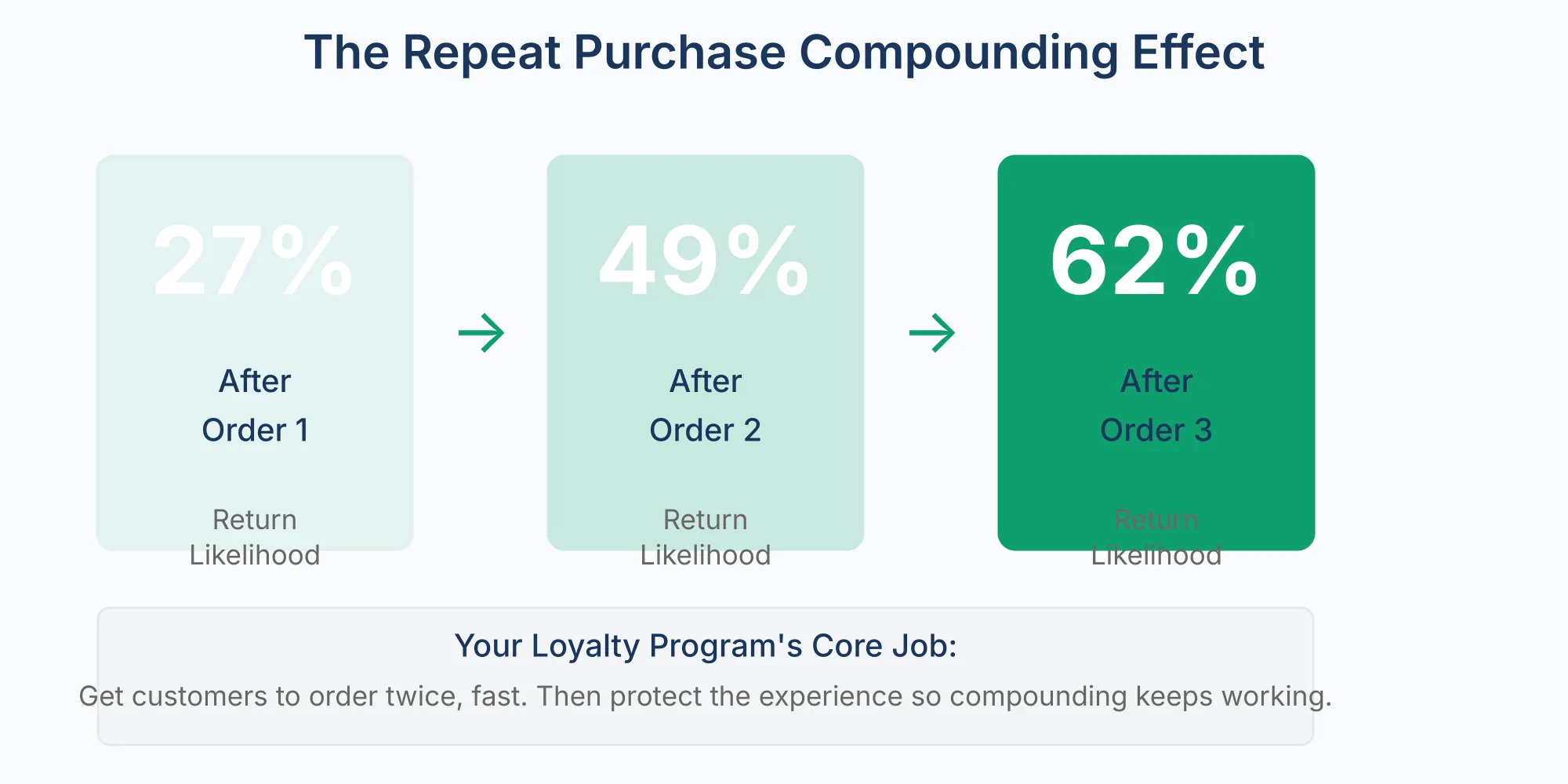
After Order 1: ~27% likelihood of return
After Order 2: ~49-54% likelihood of return
After Order 3: ~62% likelihood of return
The exponential improvement shows why your singular focus should be: Get customers to order twice, fast. Then protect the experience so the compounding keeps working.
A customer who makes a second purchase is 2x more likely to make a third. That customer is now in the "repeat buyer" category, and the lifetime value math changes dramatically.
This is not a loyalty program problem it's a loyalty program solution. Programs create the mechanism to get that second purchase and then the reminders and incentives to keep the compounding going.
Understanding Loyalty Program Types (And Which Work Best)
The loyalty program types available on Shopify include: Points-based programs (customers earn points for purchases and actions, then redeem for discounts or free products), Tiered VIP programs (status levels unlock progressively better perks based on lifetime spend), Paid membership programs (customers pay monthly or annually for exclusive benefits), Cashback programs (flat percentage back on every purchase as store credit), and Referral programs (dual-sided rewards for both the advocate and the new customer).
Program Type #1: Points-Based Loyalty
How It Works: Customers earn points on every purchase (typically 1-5 points per $1 spent) and redeem at specific thresholds (e.g., 100 points = $10 off).
Best For: Stores with frequent purchases (beauty, supplements, food, apparel)
Pros:
- Easy to understand
- Immediate sense of progress
- Works well for consumables
- High engagement rates
Cons:
- No inherent status or aspiration
- Discount-dependent (trains customers to wait for promos)
- High redemption costs eat into margin
Typical Results: 12-18% higher annual spend, 3.3x purchase frequency
Setup Time: 15-30 minutes
Program Type #2: VIP Tier Loyalty (The High-Performer)
How It Works: Customers progress through tiers (Bronze → Silver → Gold → Platinum) based on lifetime spend or purchase count. Each tier unlocks progressively better benefits.
Best For: All categories; delivers highest ROI
Tier Distribution Sweet Spot:
- Entry tier (Bronze): 60-70% of customers
- Mid tier (Silver): 20-30% of customers
- Top tier (Gold/Platinum): 5-10% of customers
Pros:
- Creates emotional investment and status recognition
- Top-tier VIP members generate 8.7x higher repeat purchases than entry-level customers
- Achieves 1.8x higher ROI than non-tiered structures
- 50% of consumers actively change purchasing habits to reach higher tiers
- Supports non-discount rewards (early access, exclusive products, free shipping)
Cons:
- Requires more sophisticated app
- Setup takes 1-3 days with customization
- Must balance aspiration with attainability
Typical Results: VIP customers generate 73% higher AOV and purchase 3.6x more frequently
Setup Time: 30 minutes (basic) to 3 days (customized)
Program Type #3: Paid Membership (Subscription)
How It Works: Customers pay monthly/annually ($5-50/month typical) for exclusive perks like free shipping, exclusive discounts, or early access.
Best For: High AOV categories (luxury, fashion, supplements)
Pros:
- High margin (membership fee is recurring revenue)
- Self-selects engaged customers
- Builds predictable revenue
Cons:
- Requires strong value proposition to justify fee
- Lower participation rates than free programs
- Churn risk if perceived value drops
Typical Results: Premium members spend 2-3x more, but lower overall adoption
Setup Time: 2-4 hours
Program Type #4: Referral & Advocates
How It Works: Reward customers for referring friends. Dual-sided rewards (both referrer and referee get a discount/credit).
Best For: Product-led growth brands; complements points/tier programs
Pros:
- Referred customers make 2x more purchases than non-referred customers
- Low cost per acquisition
- Compounds with VIP tiers (VIPs become advocates)
Cons:
- Lower engagement than points/tiers alone
- Requires critical mass to work well
- Quality of referred customer varies
Typical Results: 15-40% of customers make at least one referral; 2x purchase frequency for referred customers
Setup Time: 30-45 minutes
The Winning Combination: Points + VIP Tiers + Referral
Top performers combine all three:
- Points layer - Gamification and immediate gratification
- VIP tiers - Status and aspiration
- Referral module - Multiplies reach through advocates
This gives you engagement at every stage of the customer journey and creates multiple paths to retention.
How to Structure VIP Tiers for Maximum Revenue
A well-structured tiered loyalty program creates hierarchical reward structures where customers unlock progressively better benefits as they spend more. Here's how to do it without leaving money on the table:
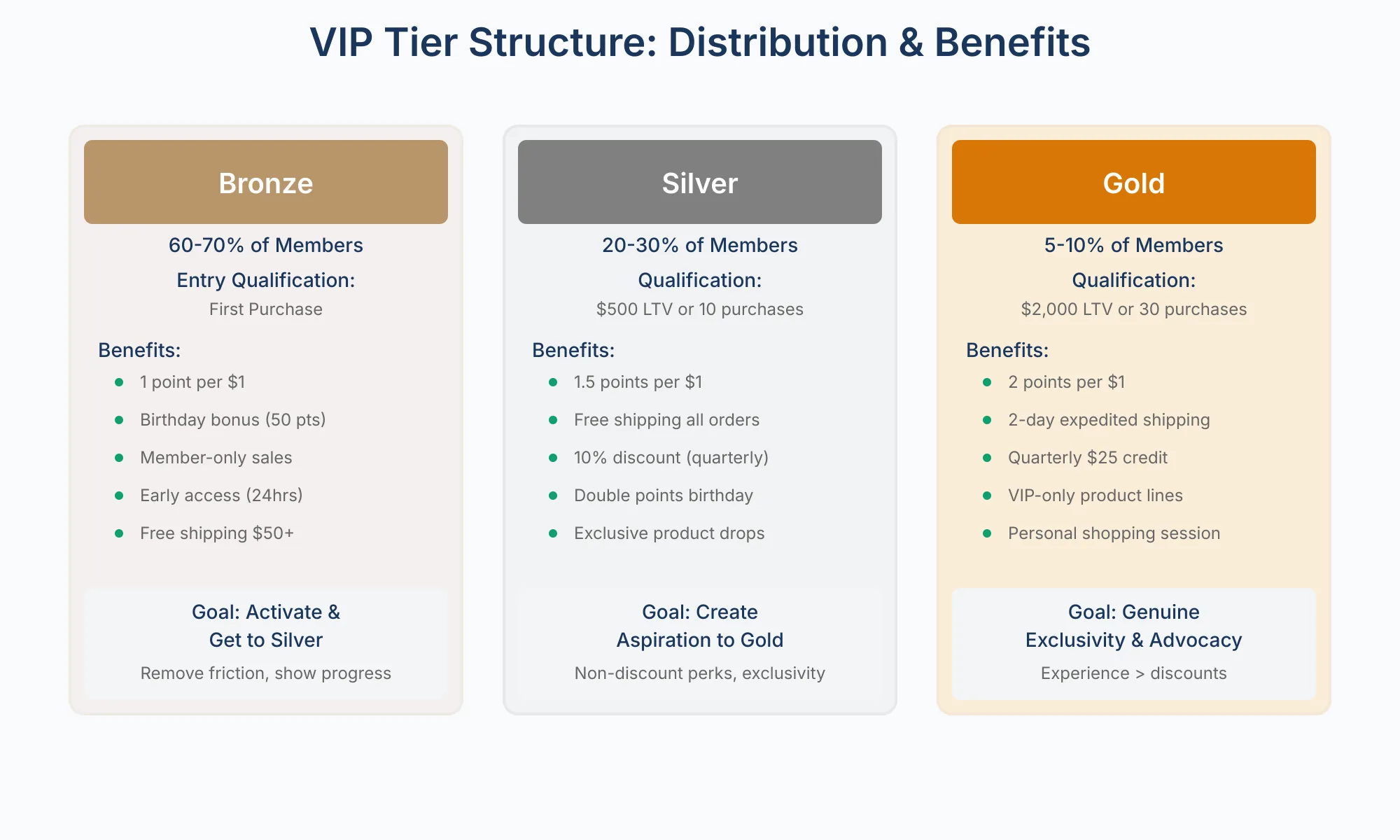
Tier 1: Entry Tier (Bronze/Member)
Qualification: Automatic upon first purchase
Earning Rate: 1 point per $1 spent
Perks:
- Birthday bonus (50 points)
- Access to member-only sales
- Early access to new products (24 hours)
- Free shipping on orders $50+
Goal: Make membership feel immediate and valuable. Remove friction from reaching Tier 2.
Tier 2: Mid Tier (Silver/VIP)
Qualification: $500 lifetime spend OR 10 purchases in rolling 12 months
Earning Rate: 1.5 points per $1 spent
Perks:
- Free shipping on all orders
- 10% discount code (quarterly)
- Double points on birthday month
- Exclusive product drops (5 days early access)
- Free gift wrapping
Goal: Create aspiration. Mid-tier members should see clear upgrade path to Gold.
Psychology: At this spend level, customers are emotionally invested. Non-discount perks (early access, exclusive products) cost less but feel more premium than discounts.
Tier 3: Top Tier (Gold/Platinum)
Qualification: $2,000 lifetime spend OR 30 purchases in rolling 12 months
Earning Rate: 2 points per $1 spent
Perks:
- Free expedited shipping (2-day)
- Quarterly $25 credit (instead of discounts)
- VIP-only product lines
- Personal shopping session (email-based, once per quarter)
- Exclusive event invitations
- 50% faster customer support (dedicated email)
Goal: Create genuine exclusivity. Top-tier members are your highest-value customers treat them as such.
Budget Reality: Experiential rewards (early access, exclusive products, personal shopping sessions) outperform discounts for VIP retention while costing 40-60% less
The Retention Sequence: How to Activate Members
Having a loyalty program does nothing if customers don't know it exists or don't understand how to participate. You need a structured activation sequence.
Sequence #1: Post-Purchase Activation (Day 0-2)
Goal: Get first-time customers enrolled before they forget
Tactics:
- Order confirmation email + loyalty enrollment CTA (prominent, above the fold)
- SMS (if opted-in): "You earned 100 points! Redeem for $10 off. [Link]"
- Loyalty dashboard widget (show progress immediately)
Expected Results: 35-50% enrollment rate
Sequence #2: Early Tier Education (Day 3-7)
Goal: Help customers understand the path to Tier 2 and why it matters
Tactics:
- Email: "You're 9 purchases away from free shipping forever. Here's your roadmap." (show tier progress visually)
- SMS: "Silver members get 1.5x points. You're close! [Link to see how]"
- On-site banner: Tier progress bar in account dashboard
Expected Results: 40% of enrolled customers engage with tier information
Sequence #3: Redemption Reminder (Day 14-21)
Goal: First redemption is critical (creates habit loop)
Tactics:
- Email: "You have 120 points. Redeem for $12 off your next order [Link]"
- SMS: "Ready to use your points?"
- Create an easy redemption experience (1-click apply at checkout)
Expected Results: 50% of customers who redeem become repeat buyers vs 10.7% for non-redeemers
Sequence #4: Re-Engagement for Inactive Members (Day 45+)
Goal: Bring back lapsed members with targeted incentives
Tactics:
- Email: "It's been 30 days. Your 150 points expire in 60 days here's something perfect for you [Product recommendation]"
- SMS: "Miss 20% off? Your points unlock it. [Redemption link]"
- Segment by tier: Gold members get "We miss you, VIP" treatment; new members get "Let's get you to Silver"
Expected Results: 20-30% reactivation of lapsed members
Loyalty Program Economics: Cost vs. ROI
Loyalty programs cost $2,500–$4,500 in month one and $7,720–$15,320 in year one, including software, rewards, setup, and hidden costs.
Let's model the ROI for a typical store:
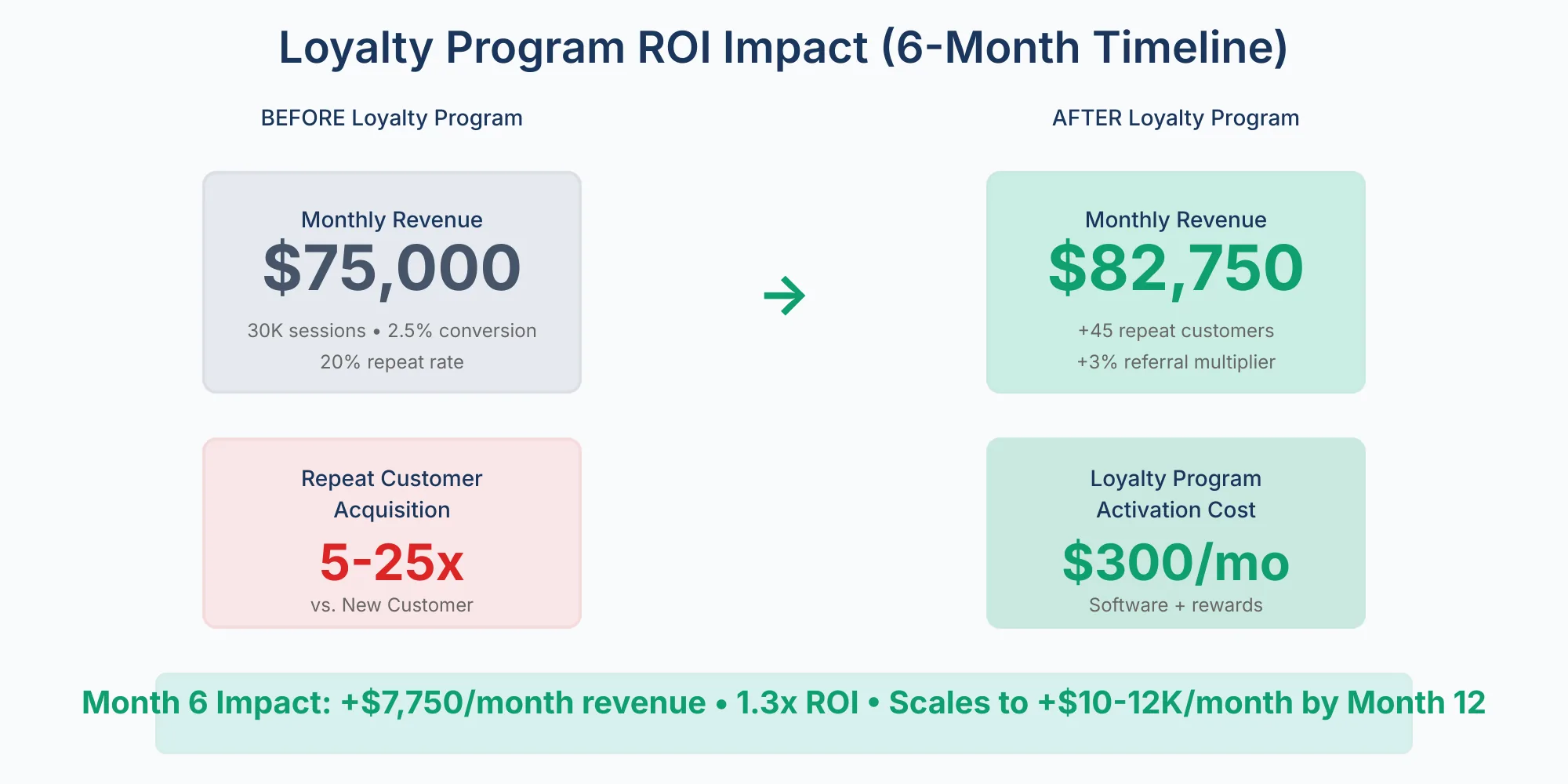
Store Profile:
- 30,000 monthly sessions
- 2.5% overall conversion rate = 750 orders/month
- Current repeat rate: 20% (150 repeat customers/month)
- $100 AOV
- Current monthly revenue: $75,000
Loyalty Program Investment:
- Software: $100-300/month (Smile.io, Yotpo, Rivo)
- Rewards (discounts, credits): 3-5% of member revenue
- Setup: One-time $1,000 (implementation, design, emails)
Conservative Outcome (6 months):
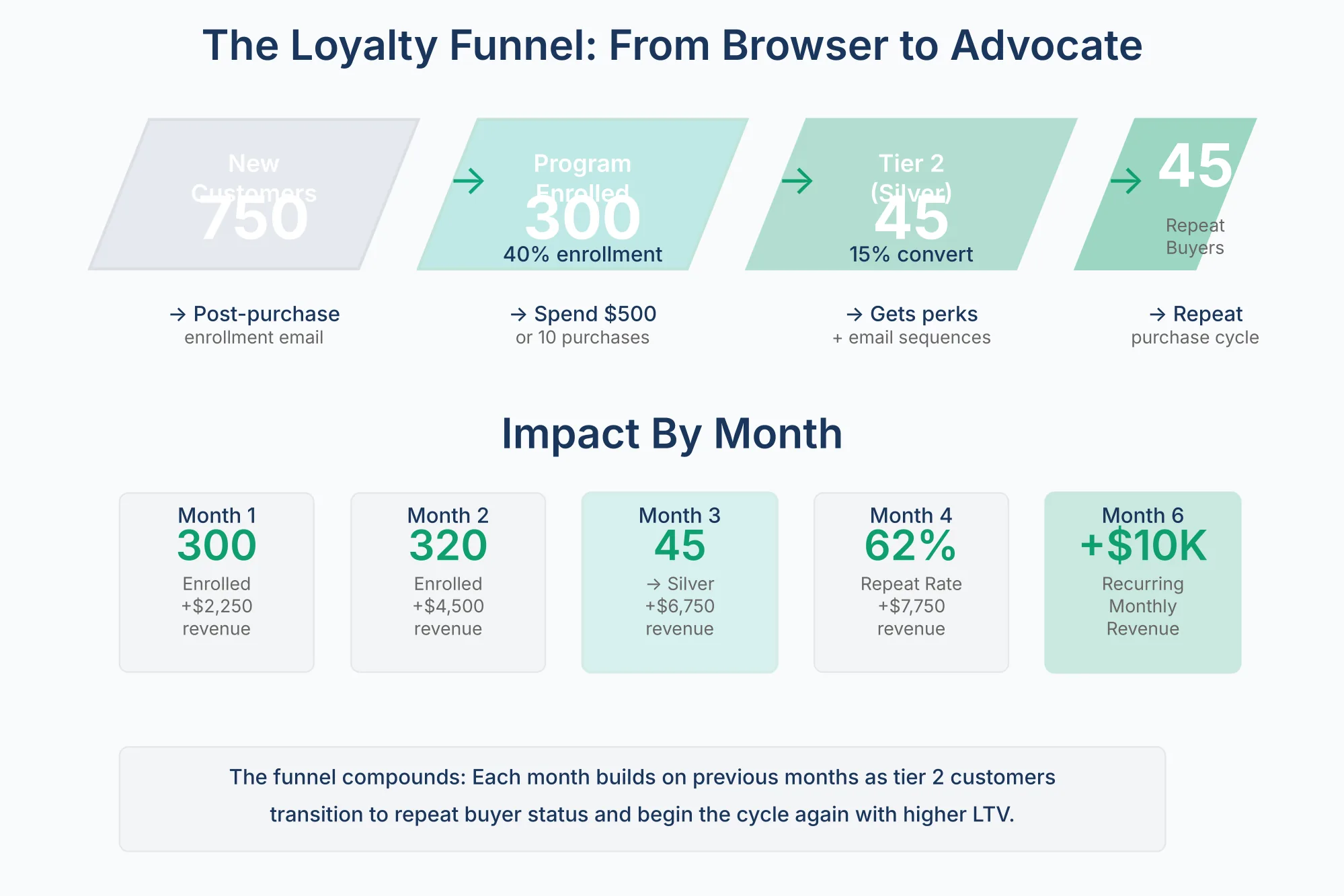
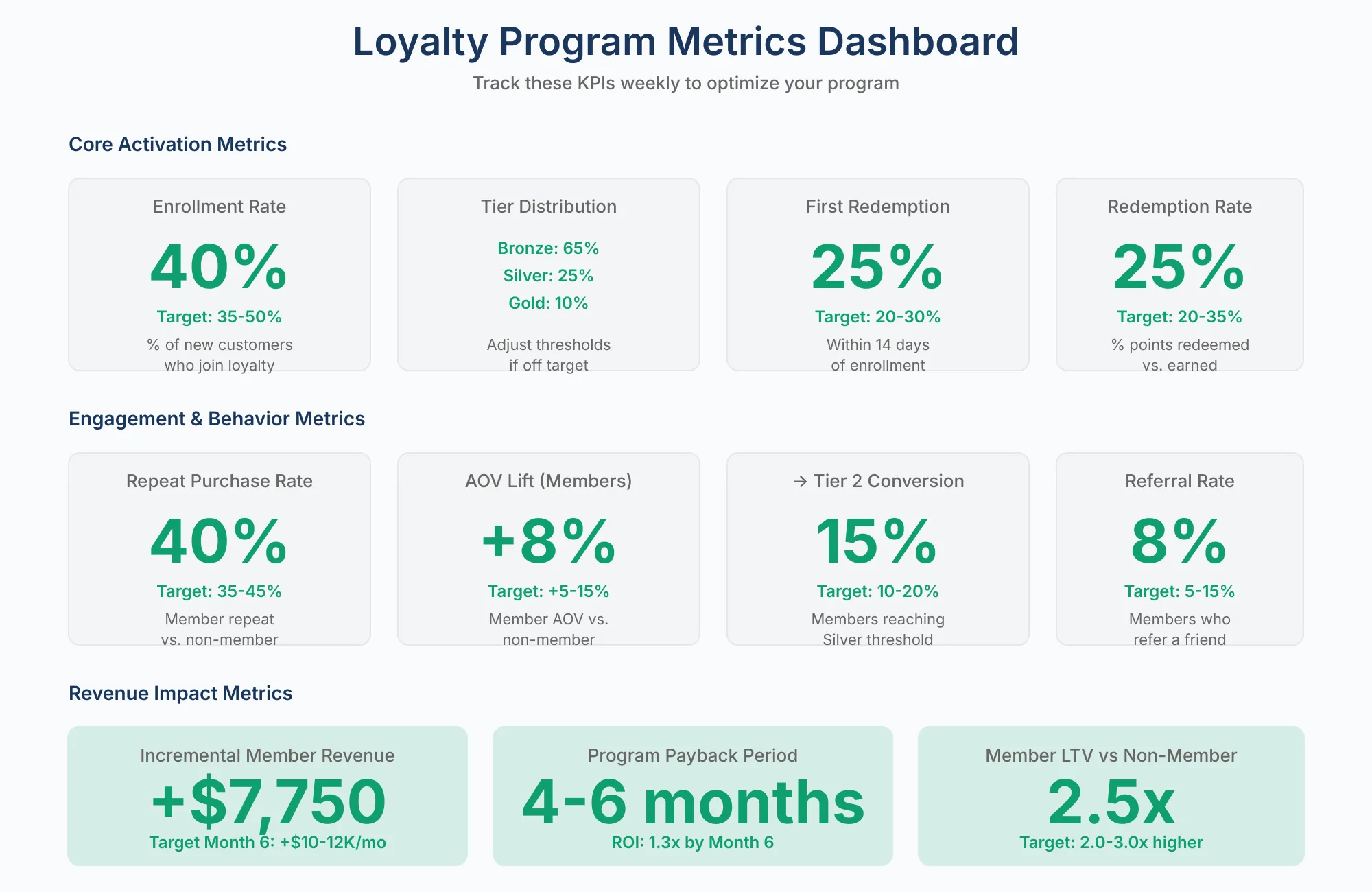
- Enrollment: 40% of new customers = 300/month
- Tier 2 conversion: 15% of enrolled → 45 additional repeat purchases/month
- Lift in AOV for members: +$8 per order
- Referral multiplier: +5% incremental volume
Month 6 Impact:
- Additional repeat customers: 45
- Additional revenue from existing members: +$4,000
- Additional referral revenue: +$3,750
- Total incremental monthly revenue: +$7,750
6-Month Investment:
- Software ($2,700 = $300 × 9 months)
- Rewards cost (5% of incremental $46,500): $2,325
- Setup: $1,000
- Total cost: $6,025
Month 6 ROI: +$7,750/month revenue on $6,025 spend = 1.3x immediate payback, scaling from there
By month 12, the program is likely generating $10,000-12,000/month in incremental revenue with zero additional acquisition spend.
The 90-Day Loyalty Program Launch Roadmap
Phase 1: Planning & Setup (Weeks 1-2)
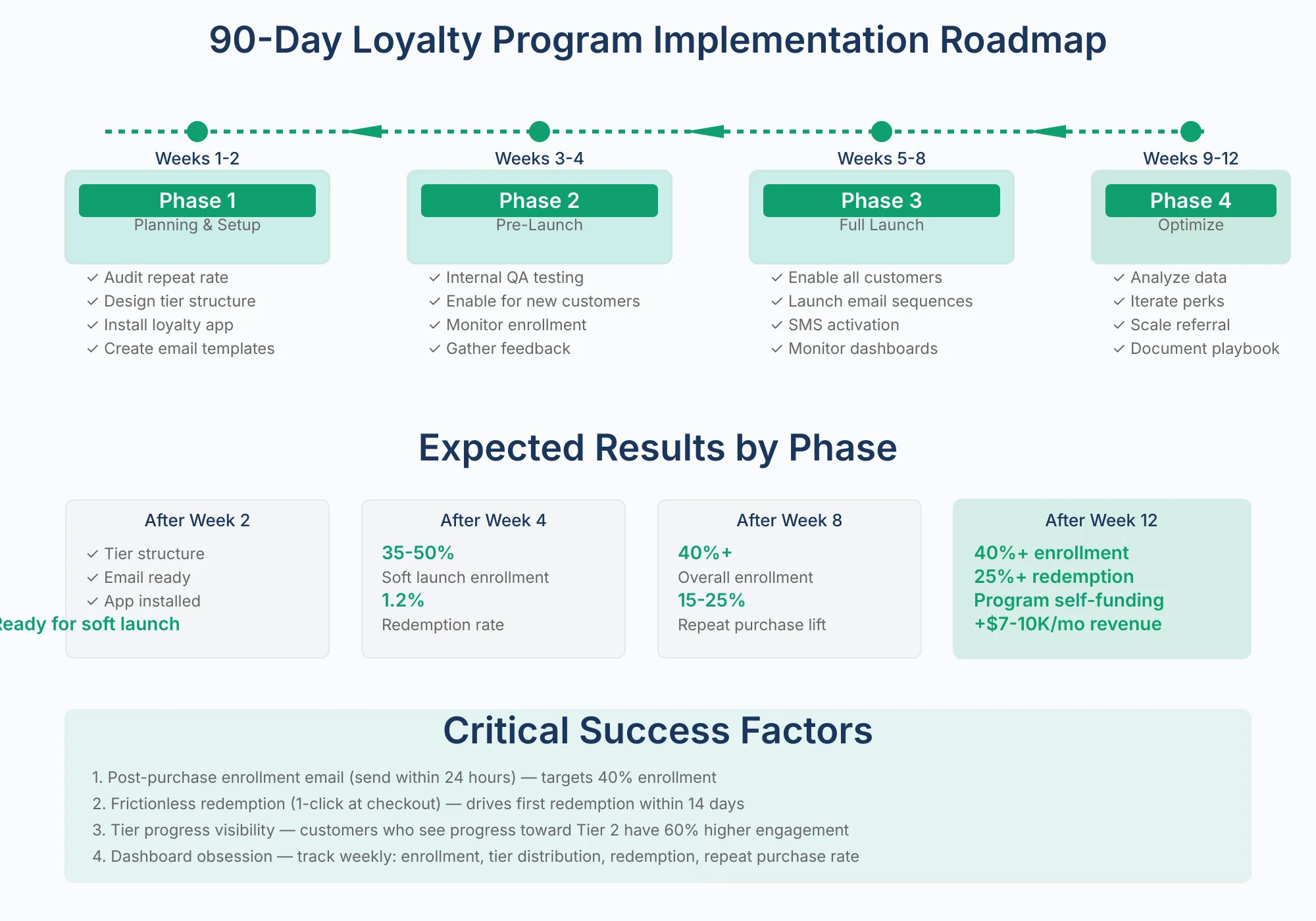
Week 1: Discovery
- Audit current repeat rate, CLV by customer segment
- Identify your repeat customers (analyze last 12 months of data)
- Determine which program type fits: points + tiers + referral (recommended)
- Define tier thresholds (e.g., $500 for Silver, $2,000 for Gold)
- Set reward perks (balance cost vs perceived value)
Week 2: Technical Setup
- Select loyalty app (Smile.io, Yotpo, Rivo recommended)
- Install app on Shopify (15 minutes)
- Configure points earning rules (1 point per $1 default)
- Set tier thresholds and unlock perks
- Design tier names and branding
- Create email templates for enrollment + tier announcements (see our Email & SMS Retention guide for complete sequence automation)
Deliverables:
- Documented tier structure with spending thresholds
- Email templates (5 key sequences)
- Landing page or in-app messaging explaining program
Phase 2: Pre-Launch (Weeks 3-4)
Week 3: Internal Testing
- Run test purchases through loyalty flow
- Check point accrual, tier progression, redemption
- Test email sequences (make sure they send to correct segments)
- Verify dashboard displays correctly
Week 4: Soft Launch
- Enable loyalty program for all new customers only
- Monitor enrollment rates (target: 35%+)
- Test redemption flow (make sure it's frictionless)
- Gather feedback (internal team + early adopters)
Deliverables:
- QA sign-off on all flows
- Soft launch report (enrollment %, redemption %)
Phase 3: Full Launch + Activation (Weeks 5-8)
Week 5: Expand to All Customers
- Enable loyalty for all existing customers (retroactive points if possible)
- Announce via email (send to entire list)
- Update homepage, product pages, checkout with loyalty CTA
- Train support team on loyalty questions
Week 6-8: Activation Sequences
- Send post-purchase enrollment emails to new customers
- Email existing customers about tier status
- SMS campaigns for opt-in customers (enrollment, tier education)
- Monitor metrics: enrollment, tier distribution, redemption rate
Key Metrics to Track:
- Enrollment rate (target: 40%+)
- Tier distribution (should match 60-20-10 split)
- Redemption rate (target: 25%+ of points earned are redeemed)
- Repeat purchase rate among members (target: 40%+)
Deliverables:
- Weekly dashboard showing program performance
- Customer segmentation report (who is in each tier?)
- Redemption analysis (which rewards are most popular?)
Phase 4: Optimization (Weeks 9-12)
Week 9-10: Analyze & Iterate
- Review enrollment, tier distribution, redemption data
- Identify underperforming tiers (adjust thresholds if needed)
- Test new perks or email sequences
- Analyze repeat purchase lift (should see 15-25% by now)
Week 11-12: Scale
- Expand referral program (VIPs can refer for bonus points)
- Add SMS channel (if not already active)
- Plan seasonal campaigns (holiday bonuses, tier challenges)
- Document playbook for ongoing management
Expected Results by Week 12:
- 40%+ member enrollment
- 15-25% lift in repeat purchase rate
- +5-10% revenue from member segments
- Tier distribution near target (60-20-10)
- Program paying for itself
Deliverables:
- 90-day performance report
- Optimization recommendations for Q2+
- Operating playbook (ongoing management)
Connecting to Your Broader Shopify Growth Strategy
Spoke #4 fits into the complete Shopify growth ecosystem like this:
- Spoke #1 (AI Product Discovery) - Gets you discovered
- Spoke #2 (TikTok Shop) - Brings impulse shoppers
- Spoke #3 (CRO) - Converts visitors into customers
- Spoke #4 (Loyalty Programs) ← YOU ARE HERE - Turns buyers into repeat customers
- Spoke #5+ (Email/SMS Retention, etc.) - Multiplies lifetime value
The compounding effect is powerful: A 50% improvement in repeat purchase rate means every customer from Spokes #1-3 is worth 50% more lifetime revenue. And loyalty programs directly address the repeat purchase problem.
Frequently Asked Questions
Q: What's a good repeat purchase rate to target?
A: Average ecommerce repeat rate is 30%, with ranges from 15-30% depending on category. High-performing categories like food/beverage and supplements reach 45-52%. Start with understanding your baseline, then target 5% annual improvement.
Q: How long until we see ROI on a loyalty program?
A: Quick wins appear in 30 days (enrollment, first redemptions). Meaningful revenue impact takes 60-90 days as you build tier distribution and repeat purchases compound. Full payback is typically Month 4-6.
Q: Should we offer discounts or experiences?
A: Experiential rewards (early access, exclusive products, personal shopping sessions) outperform discounts for VIP retention while costing 40-60% less. Use discounts to drive entry-tier engagement; use experiences for VIP retention.
Q: How do we prevent race-to-the-bottom on rewards?
A: Structure tiers to naturally reduce discount dependency. Entry tiers get modest discounts; mid tiers get free shipping; top tiers get non-discount perks. The goal is to train customers that higher tiers get better benefits, not more discounts.
Q: Can we retrofit points to existing customers?
A: Yes. Most loyalty apps allow retroactive point accrual (e.g., 1 point per $1 of past purchases). This helps existing customers feel included and accelerates tier progression.
Q: What's the minimum store size to launch loyalty?
A: Skip if you are processing fewer than 50 orders per month or still validating product-market fit. A loyalty program will not fix a conversion or traffic problem. You need consistent monthly order volume (ideally 100+) for a program to make sense.
Q: How do we measure program ROI?
A: Compare CLV of loyalty members vs non-members. Track: repeat purchase rate, average order value, purchase frequency, and customer lifetime value. Use cohort analysis (members acquired Month 1 vs Month 6) to see how behavior changes over time.
Implementation Tools & Recommended Apps
The best loyalty program for Shopify in 2026 is Smile.io because it's built specifically for Shopify with the deepest integration, comprehensive features including points, referrals, and VIP tiers, and a free plan for stores under 200 monthly orders. Other top options include Yotpo Loyalty, Rivo, and Stamped Loyalty, each with different strengths in customization vs ease of use.
All of these integrate natively with:
- Email marketing (Klaviyo, Omnisend, Attentive)
- SMS (Twilio, Attentive)
- Shopify POS (for omnichannel consistency)
- Analytics (GA4, custom dashboards)
What Not to Do (Common Loyalty Program Mistakes)
- Making it too complicated - Simple beats sophisticated. Points + 2-3 tiers = 80% of the value.
- Launching with zero promotion - 50% of enrolled customers come from post-purchase emails. You must actively promote.
- Offering irrelevant rewards - "Free $5 off" in a luxury brand looks cheap. "VIP early access" feels premium.
- Not tracking correctly - If you can't measure repeat purchase lift, you can't optimize. Dashboard obsession is required.
- Forgetting the second purchase - After the first purchase, return likelihood is 27%. After the second, it jumps to 49-54%. Your job is to get customers to order twice. Everything else follows.
This guide reflects 2026 loyalty program realities based on data from Rivo, Joy.so, Smile.io, Yotpo, and performance benchmarks from 100,000+ Shopify stores.