Part of the ShopifyLift Series
Start here: The Shopify Growth Guide 2026: Key Strategies and Trends Every Merchant Should Know
Related deep dives:
Email and SMS Retention Sequences for Shopify: The Complete Playbook for Repeat Revenue
Here's the uncomfortable truth: Acquiring a new customer costs 5-7x more than retaining an existing one. Yet most Shopify merchants obsess over paid ads, landing pages, and conversion rate optimization while letting customers disappear after a single purchase.
Email and SMS retention sequences are the profit engine you're leaving on the table.
A single well-designed email sequence can recover $50K/month in abandoned carts. A post-purchase sequence can shift repeat purchase rate from 12% (industry average for new e-commerce stores) to 25-35% (top performers). An SMS win-back campaign can reactivate dormant customers at 40%+ response rates. Combined, these three tactics can lift annual revenue by 30-40% without increasing customer acquisition spend.
Here's what changed in 2026: Shopify's native email and SMS tools became genuinely competitive with third-party platforms. Klaviyo remains the gold standard for agency-scale customization, but for most merchants (sub-$5M ARR), Shopify Email + SMS Channels now offer 80% of the functionality at 10% of the cost. Compliance has tightened (GDPR, CASL, CAN-SPAM, GDPR reforms), but clear consent flows and compliance tooling have improved in tandem.
This guide walks through the six retention sequences every Shopify merchant should run, how to design each for maximum conversion, when to deploy SMS vs email, how to segment your audience, how to measure ROI, and how to avoid the compliance and deliverability landmines that tank campaigns.
Why Retention Beats Acquisition (The Math)
Before diving into sequences, understand the economics.
Customer Acquisition Cost (CAC) vs. Lifetime Value (LTV)
Typical Shopify store (D2C apparel, $100 AOV, 3x markup):
| Metric | Value |
|---|---|
| Paid ad CAC | $35–$50 |
| Organic/referral CAC | $8–$15 |
| Blended CAC | $20–$30 |
| First-order AOV | $100 |
| First-order margin (40%) | $40 |
| Repeat purchase rate (baseline) | 12% |
| Repeat purchases per customer (24 months) | 2.9 |
| Repeat purchase AOV | $95 (slightly lower) |
| Repeat purchase margin (40%) | $38 |
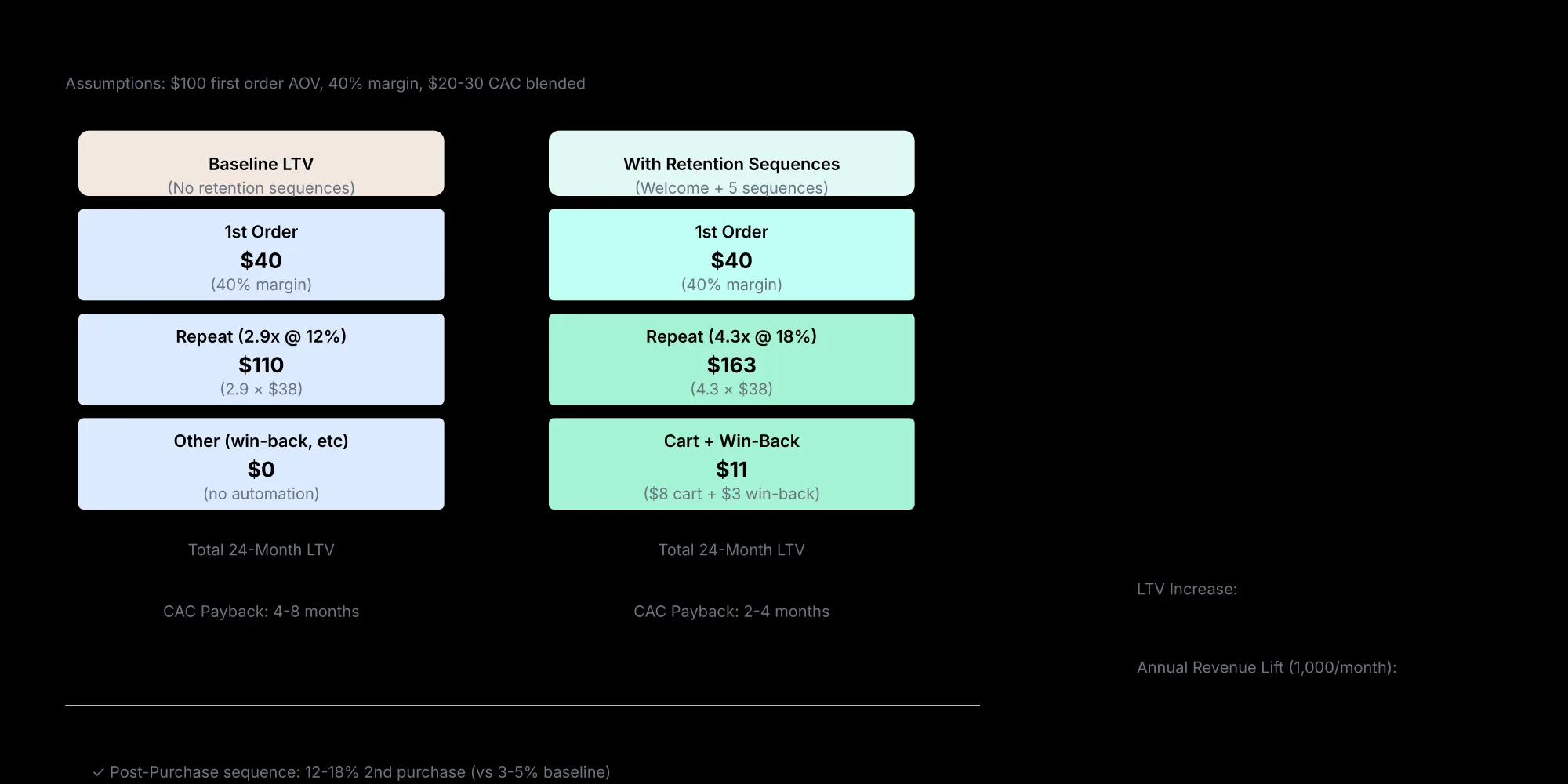
LTV calculation (24 months):
- 1st order: $40 margin
- 2.9 repeat orders: 2.9 × $38 = $110
- Total LTV (unadjusted): $150
- CAC payback: 4–8 months
- LTV:CAC ratio: 5:1 (healthy)
Now introduce retention sequences:
A post-purchase email sequence (order confirmation, product care, cross-sell, loyalty offer) shifts repeat purchase rate from 12% → 18%.
An abandoned cart email (24 hours) recovers 30-40% of lost carts.
An SMS win-back sequence reactivates 15-20% of dormant customers.
| Metric | New LTV |
|---|---|
| 1st order margin | $40 |
| Repeat purchase rate (baseline 12% → 18%) | 4.3 purchases |
| Repeat margin (4.3 × $38) | $163 |
| Abandoned cart recovery (at 5% conversion, $80 order margin) | $8 |
| Win-back reactivation (at 20%, $90 margin) | $3 |
| New total LTV (24 months): | $214 |
Impact: 43% LTV increase with retention sequences.
For a 1,000-customer/month store:
- Annual new customers: 12,000
- LTV lift: $214 − $150 = $64/customer
- Annual revenue impact: 12,000 × $64 = $768,000 additional revenue
- Cost to implement (Shopify Email + SMS Channels): ~$500/month = $6,000/year
- ROI: 12,800%
This is why retention sequences aren't optional. They're the highest-ROI marketing lever you have.
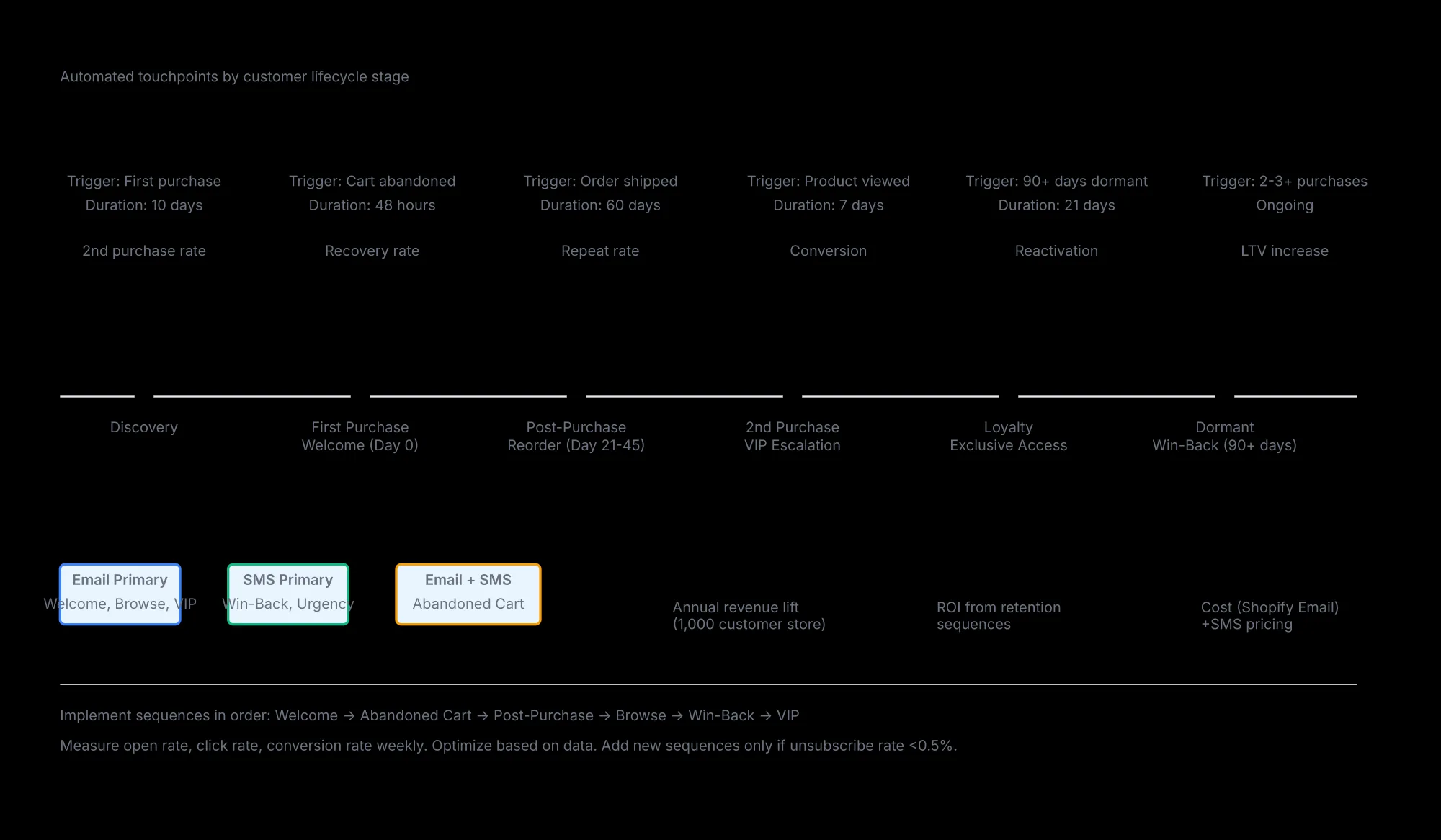
The Six Core Retention Sequences Every Store Needs
Sequence #1: Welcome Series (Email, 5 emails over 10 days)
Trigger: Customer makes first purchase
Goal: Build relationship, gather preferences, drive second purchase within 30 days
Expected Impact: 18-25% of customers make repeat purchase within first month (vs. 3-5% without)
Email 1: Order Confirmation (sent immediately)
- Transactional (must-send)
- Order summary, shipping info, tracking number
- Tone: Professional, helpful
- Add: Link to product care guide + brand story
- CTA: "View Product Care Guide" (build habit of going back to your content)
Email 2: Product Care & Maximize Value (24 hours post-ship)
- How to use product correctly (reduce returns, increase satisfaction)
- Example: "How to Care for Your Merino Hoodie" (with video)
- Tone: Helpful, expert
- CTA: Secondary product recommendation (complementary SKU from video)
- Key stat: Customers who click product care links repurchase 2.8x more often
Email 3: Brand Story (3 days)
- Your origin, mission, values
- Customer testimonial or case study
- Tone: Conversational, emotional
- CTA: "Explore our full collection"
- Goal: Shift customer from "I bought a hoodie" to "I support this brand"
Email 4: Exclusive Offer (6 days)
- First-time loyalty offer: 15-20% off next purchase, or free shipping over $50
- Message: "Welcome to our community here's something just for you"
- Tone: Generous, time-limited
- CTA: "Claim your discount"
- Constraint: Valid for 14 days only (creates urgency)
- This email drives ~40% of welcome series conversions
Email 5: Preference Center (10 days)
- "Help us send you what matters"
- Frequency preference (weekly/monthly/never)
- Category preferences (new arrivals, sales, content, events)
- Tone: Collaborative
- CTA: "Set your preferences"
- Goal: Reduce unsubscribes and segment for future campaigns
Expected sequence metrics:
- Open rate: 45-55% (first email, ~30%; Email 4 discount, ~60%)
- Click rate: 15-20% overall
- Conversion rate (Email 4 exclusive): 8-12% of new customers repurchase within 30 days
- Revenue from this sequence: ~$20-40 per 100 customers on a $100 AOV store
Sequence #2: Abandoned Cart Email (Email + SMS, 3 touchpoints over 48 hours)
Trigger: Customer abandons cart without checkout
Goal: Recover 25-40% of abandoned cart value within 48 hours
Expected Impact: 3-5% of monthly revenue from recovered carts alone
Email 1: First Cart Recovery Email (1 hour delay)
- Subject: "You left something behind" or "Your [product name] is waiting"
- Show cart image + items + price
- Message: Simple ("Forgot something?") or helpful ("Is there anything we can help with?")
- Tone: Light, non-pushy
- CTA: "Complete your purchase"
- Critical: Do NOT offer a discount at this stage (many will return and buy)
- Expected recovery rate: 8-10%
Email 2: Gentle Reminder + Shipping Info (24 hours)
- "Still thinking about it? Here's what you're missing..."
- Show product benefits, social proof (reviews), shipping info
- Add: Quantity/size availability ("Only 3 left in your size")
- Tone: Informative, light FOMO
- CTA: "Finalize order"
- Expected recovery rate: 5-7%
Email 3: Incentive + Urgency (36–42 hours)
- Now offer the discount: 10-15% off or free shipping
- Message: "Last chance this deal expires in 12 hours"
- Show product image, reviews, shipping info
- Tone: Friendly urgency
- CTA: "Claim discount + complete purchase"
- Expected recovery rate: 8-12%
SMS Companion (optional, high-performing):
- Send SMS #1 (same-day, 6 hours after cart abandonment): "You left $XX in your cart. Finish checkout here [link] 🛒"
- Send SMS #2 (next day, if email opened but no click): "$15 off your order reply SHOP to finish checkout"
- SMS conversion: 5-8% (higher than email because SMS is intrusive and has 98% open rate)
- Best practice: SMS for high-value carts ($150+); email for standard carts
Expected cart abandonment sequence metrics:
- Recovery rate: 25–40% of abandoned carts
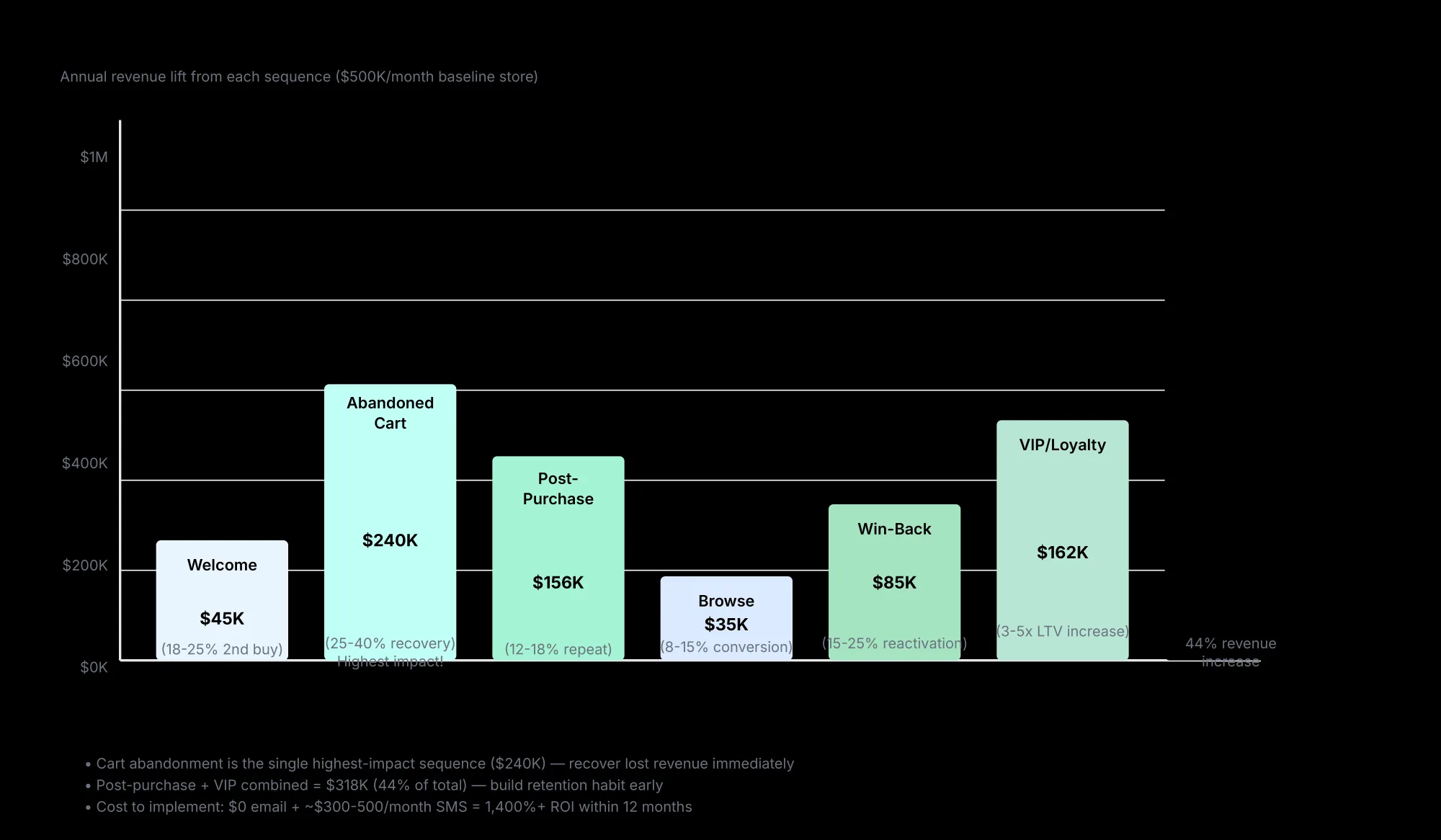
- Revenue: If $500K/month store with 15% abandonment ($75K abandoned weekly), recover $18.75K/week = $975K/year
- Cost: $0 (Shopify Email is free; SMS is ~$0.02 per message)
- ROI: Infinite for email, 1000%+ for SMS
Sequence #3: Post-Purchase/Reorder Sequence (Email + SMS, 6+ emails over 60 days)
Trigger: Customer completes purchase and product ships
Goal: Drive second purchase within 45-90 days, build habits
Expected Impact: Shift repeat purchase rate from 12% to 25-30%
Email 1: Order Confirmation (transactional, immediate)
- As above (order summary + tracking)
Email 2: Shipping + Cross-sell (3 days)
- "Your order is on the way here's what else our best customers bought"
- Show 3-4 complementary products (curated, not generic)
- Use product data and optimization to recommend: If they bought a teal hoodie, show matching sweatpants with high-converting product pages, not random products
- CTA: "Shop now"
- Conversion rate: 8-12%
Email 3: Product Care Guide (7 days)
- Maximize satisfaction, reduce returns
- Video or detailed text on how to care for product
- Include: Washing instructions, styling tips, longevity benefits
- CTA: "View care guide" (link to help docs)
Email 4: Unboxing Experience (10 days)
- If the product has arrived, ask for feedback
- Message: "How's your [product]? Show us on Instagram"
- Include: Photo contest or user-generated content appeal
- Tone: Community-building
- CTA: "Tag us on Instagram @brandname"
- Goal: Generate content, build social proof for others
Email 5: First Repeat Offer (21 days)
- "We hope you love your [product]. Here's 15% off your next order"
- Reorder window: Valid for 30 days
- Message: "These items pair well with what you bought"
- Show repeat-purchase-compatible products (not identical)
- CTA: "Shop with 15% off"
- This email is your highest-conversion reorder driver
- Expected conversion: 12-18% of customers who received this email reorder within 45 days
Email 6: Love It? Let Us Know (35 days)
- Review request + photo contest
- Message: "4-star reviews help other customers discover [product]"
- CTA: "Write a review" or "Share your photo"
Email 7: Inventory Alert / New Arrivals (45 days)
- If product is seasonal or limited edition: "This [product] is selling fast"
- If they seem dormant: Show new arrivals in same category
- CTA: "Explore new products"
SMS companion (optional):
- SMS 1 (7 days): "Your [product] order arrived! Tips to make it last 🧵"
- SMS 2 (21 days): "Love it? 15% off your next order reply SHOP"
- SMS 3 (45 days): "Miss your [product]? New arrivals just dropped 🎉"
Expected post-purchase sequence metrics:
- Emails opened: 35-45%
- Repeat purchase rate from this sequence: 12-18% of recipients order within 45 days
- Revenue per 100 customers: If 100 customers buy at $100 AOV, 15 reorder at ~$100 = $1,500 incremental revenue
- Cost: $0 (Shopify Email free)
- ROI: Infinite
Sequence #4: Browse Abandonment / Browse Recovery (Email, 2-3 emails over 7 days)
Trigger: Customer views product for 60+ seconds without adding to cart
Goal: Recover 8-15% of viewed-but-abandoned products
Expected Impact: 2-3% of monthly revenue from browse recovery
Email 1: First Browse Reminder (24 hours)
- Subject: "You were eyeing [product name]"
- Image + product details (price, ratings, benefits)
- Tone: Casual, "just a reminder"
- CTA: "See it again"
- Expected recovery: 3-5%
Email 2: Social Proof (48 hours)
- Same product, different angle
- Add: Customer reviews, styling photos, size guide
- Message: "Our customers love this [product]"
- CTA: "See reviews + buy now"
- Expected recovery: 2-4%
Email 3: Incentive (72 hours)
- Discount: 10-15% off this product
- Message: "Not sure? Here's $15 off to help you decide"
- CTA: "Get the discount"
- Expected recovery: 2-4%
Expected browse abandonment metrics:
- Browse recovery rate: 8-15% of viewed products
- Revenue: If store averages $50K/month, ~30-40% of traffic views a product without purchasing (~50 visitors/day). Recovery at 10% = $1,500–$2,500/month
- Cost: $0 (Shopify Email)
- ROI: High (easy baseline recovery)
Sequence #5: Win-Back / Reactivation Campaign (Email + SMS, 3-4 touchpoints over 21 days)
Trigger: Customer hasn't purchased in 90+ days (dormant)
Goal: Reactivate 15-25% of dormant customers
Expected Impact: 5-8% revenue recovery from inactive segment
Email 1: We Miss You (immediate)
- Subject: "We miss you come back for 20% off"
- Tone: Warm, not desperate
- Message: Mention their last purchase: "You loved [product] here's what's new"
- CTA: "See what's new"
- Show 3-5 new arrivals in their category
- Expected recovery: 5-8%
Email 2: Exclusive Offer + New Products (7 days)
- 20% off coupon, valid for 14 days
- Message: "Your exclusive comeback offer"
- Tone: VIP treatment
- Show: New best-sellers, trending products
- CTA: "Claim 20% off now"
- Expected recovery: 4-6%
Email 3: Social Proof + FOMO (14 days)
- "Join [X] customers who've rediscovered us"
- Show trending products, limited-time items
- Message: "Before this offer expires..."
- CTA: "Shop now"
- Expected recovery: 2-4%
SMS Win-Back (if opted in):
- SMS 1 (Day 1): "We miss you! 20% off your next order text WELCOME"
- SMS 2 (Day 7): "Your 20% off deal expires in 7 days reply SHOP"
- SMS conversion: 8-12% (higher than email)
Expected win-back metrics:
- Reactivation rate: 15-25% of dormant customers reorder
- Revenue per 100 dormant customers at $100 AOV: 20 customers × $100 = $2,000
- Cost: $0 (Shopify Email) to ~$1 per SMS (if using SMS for 50% of list)
- ROI: 100–2,000x
Sequence #6: VIP / Loyalty Escalation (Email + SMS, ongoing)
Trigger: Customer reaches repeat purchase threshold (2-3+ orders OR $300+ LTV)
Goal: Increase purchase frequency, basket size, and emotional loyalty
Expected Impact: VIP customers spend 3-5x more than standard customers
Email 1: Welcome to VIP (immediate upon qualification)
- Message: "You're one of our favorite customers welcome to VIP"
- Exclusive perks: Free shipping on all orders, 15-20% off, early access to sales
- Tone: Celebratory, exclusive
- CTA: "Explore VIP benefits"
Ongoing VIP Sequence (monthly or per-activity):
Email 2: Early Access Sale (before general announcement)
- Subject: "VIP Early Access 48 hours before everyone else"
- Show seasonal sale items, discounted by category
- Tone: Exclusive, time-limited
- CTA: "Access sale now"
Email 3: New Product Preview (bi-weekly)
- "First look at [new collection]"
- Message: "Your community gets exclusive access 3 days early"
- CTA: "Preview collection"
- Expected conversion: 15-25% (VIP customers are engaged)
SMS VIP (weekly or bi-weekly):
- "VIPs only: Extra 10% off this weekend 🎉"
- "New [category] arrived see it first"
- "Your exclusive code: VIP20 (valid 48 hrs)"
- SMS conversion: 12-18% (highest segment)
Expected VIP metrics:
- Purchase frequency: 2-3x baseline (2 repeat purchases/year → 4-6/year)
- Basket size: +20-30% vs. standard customers
- LTV: $500–$800 per VIP customer (vs. $150–$200 standard)
- Retention rate: 60-70% (vs. 30-40% standard)
- Revenue per 100 VIPs: ~$70K/year (vs. ~$20K/year standard)
Segmentation: The Multiplier
Running the same sequence to everyone is like sending a form letter to 1,000 people. Segmentation turns sequences into conversations.
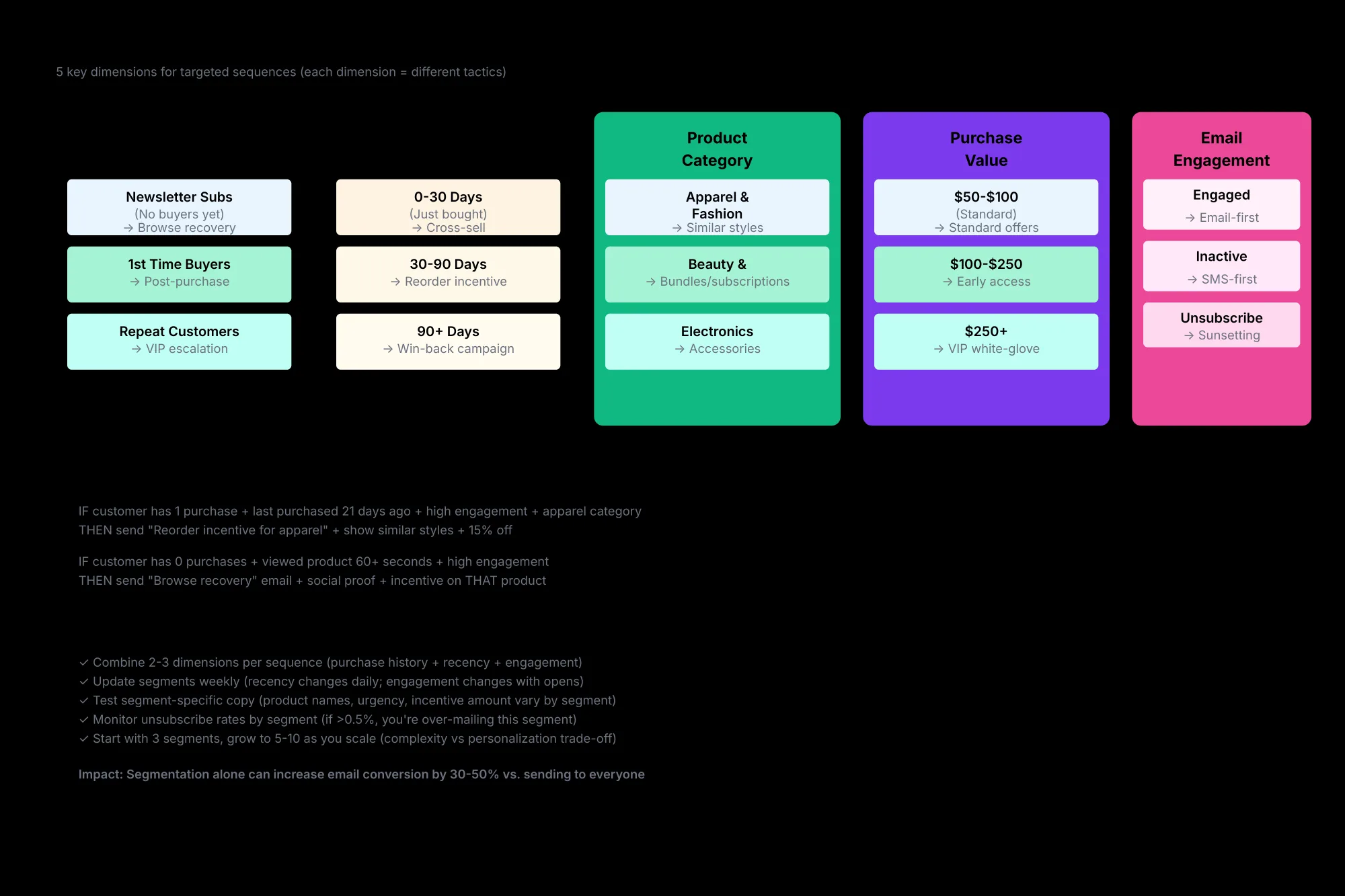
Key Segmentation Dimensions
1. Purchase History
- Zero purchases (newsletter subs, no buyers) → Welcome + browse recovery + incentive
- 1 purchase (convert to repeat) → Post-purchase + reorder offer + win-back
- 2-3 purchases (loyalists) → VIP escalation + early access + exclusive content based on loyalty tier
- 4+ purchases (advocates) → VIP benefits + referral incentives + community content tied to loyalty status
2. Recency
- Purchased in last 30 days → Post-purchase, cross-sell, early access
- Purchased 30-90 days ago → Reorder incentive, new arrivals, content
- Purchased 90+ days ago → Win-back, reactivation offer
- Never purchased → Browse recovery, incentive, educational content
3. Product Category
- If customer bought activewear → Show similar activewear, not home goods
- If customer bought luxury (>$200) → VIP treatment, exclusive offers
- If customer bought basics → Complementary items, multi-packs, subscription opportunity
4. Purchase Value
- Low-value ($50–$100) → Small incentives, free shipping over $50
- Medium-value ($100–$250) → Standard offers, early access
- High-value ($250+) → VIP treatment, concierge support, exclusive products
5. Engagement Level
- Email openers (30%+ open rate) → Email-first sequences, content
- Email avoiders (<15% open rate) → SMS-first, incentive-heavy
- SMS openers (40%+ open rate) → SMS primary channel
- Inactive (no opens/clicks in 6 months) → Sunrise/sunset review (unsubscribe or reignite)
Implementation: Shopify Email Segmentation Rules
Shopify Email supports conditional sends (if/then logic):
IF customer has made 1+ purchase
  AND customer last purchased 30-90 days ago
  AND customer opened previous email
THEN send "Reorder Incentive" email
This is simpler than a platform like Klaviyo, but sufficient for most stores. For complex multi-variable segmentation (behavioral scoring, predictive churn, RFM tiers), you'll need Klaviyo or custom integrations.
Email vs. SMS: When to Use Each
| Channel | Open Rate | Response Time | Best For | Cost |
|---|---|---|---|---|
| 18-25% (average; loyalty/retention 35-45%) | 24-48 hours | Educational content, detailed offers, passive messaging | Free (Shopify Email) to $20-100/month (Klaviyo) | |
| SMS | 95-98% | 1-5 minutes | Urgency, time-limited offers, reactivation, high-value | $0.01-0.03 per message (~$300-1000/month for 10K subscribers) |
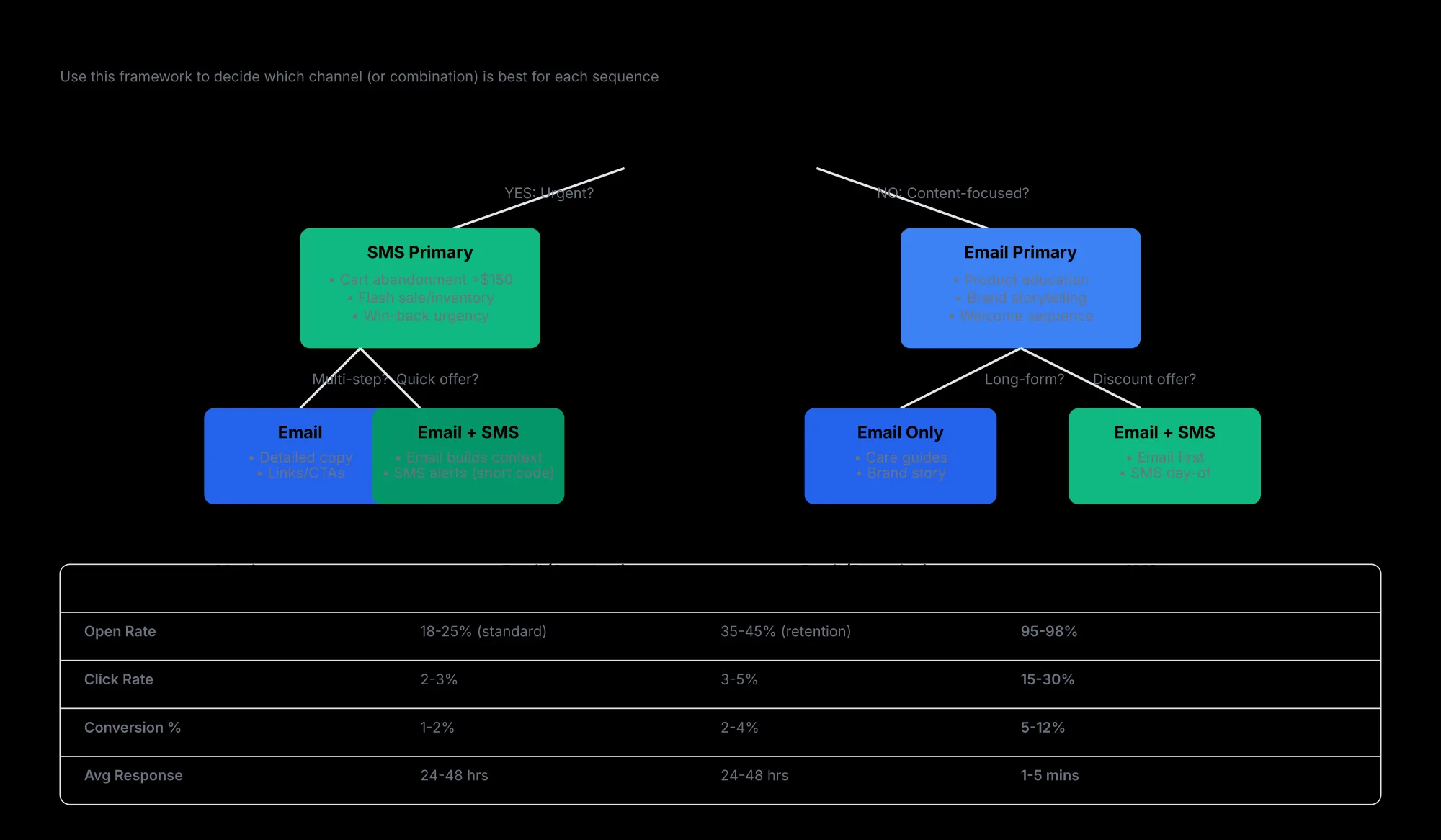
Decision tree:
- Cart abandonment: Email + SMS (email first, SMS if cart > $150)
- New product launch: Email (build context) + SMS day-of (urgency)
- Win-back/reactivation: Email + SMS (SMS 2-3x more effective)
- VIP/exclusive access: Email (build story) + SMS (alert)
- Educational content: Email only (too long for SMS)
- Transactional (order updates): SMS + email (both for reliability)
- Policy changes (returns, shipping): Email only
Compliance: The Landmines
Ignoring compliance kills deliverability and invites fines. Here's what matters:
Email Compliance (CAN-SPAM, GDPR, CASL)
CAN-SPAM (US, applies to all commercial email):
- Include your physical mailing address
- Offer unsubscribe link (must honor within 10 days)
- Avoid misleading subject lines
- Subject line should be clear (not "Act now!" if email is a promotion)
GDPR (EU, applies if you have EU customers):
- Explicit opt-in for marketing (not pre-checked boxes)
- Honor "right to be forgotten" (delete on request)
- Include privacy policy link
- Data processing agreement with email service provider
CASL (Canada):
- Explicit opt-in (stricter than CAN-SPAM)
- Clear identification of sender
- Unsubscribe link + physical address
- Violators face $15K CAD per email fine (serious)
Shopify Email compliance: Built-in templates honor CAN-SPAM + GDPR. Use them.
SMS Compliance (TCPA, GDPR)
TCPA (US):
- Explicit opt-in (not opt-out)
- Include brand name in first message
- Include unsubscribe keyword ("STOP" to unsubscribe)
- Respect quiet hours (9am–9pm recipient timezone)
- Don't send >3 messages/week per customer (best practice)
GDPR (EU):
- Same as email
Shopify SMS compliance: Shopify's SMS Channels requires opt-in. Use it.
Measuring Retention ROI: The Metrics That Matter
Key Performance Indicators (KPIs)
Email KPIs:
- Open rate (target: 25-35% for retention, 18-25% for general marketing)
- Click rate (target: 3-5% for retention, 2-3% for general)
- Conversion rate (target: 2-4% for retention sequences)
- Revenue per email (target: $0.50-1.50 for retention, $0.20-0.50 for general)
- Unsubscribe rate (alert if >0.5% per send)
SMS KPIs:
- Opt-in rate (target: 5-15% of customers)
- Delivery rate (target: 98%+)
- Opt-out rate (alert if >2% per send)
- Response rate (target: 15-30% of delivered)
- Conversion rate (target: 5-12%)
- Revenue per SMS (target: $2-10 depending on offer)
Business KPIs:
- Repeat purchase rate (target: 25-35% with retention sequences vs. 12% baseline)
- Customer lifetime value (LTV) (target: +30-40% with sequences)
- Email revenue as % of total revenue (target: 15-25% from retention channels)
- SMS revenue as % of email revenue (target: 20-30% of email ROI in similar volume)
Benchmarks by Vertical
| Vertical | Baseline Repeat Purchase | With Sequences | Email Revenue % | SMS Conversion % |
|---|---|---|---|---|
| Apparel & Fashion | 12-15% | 28-35% | 18-22% | 8-12% |
| Beauty & Cosmetics | 18-22% | 35-45% | 22-28% | 10-14% |
| Home Goods | 8-12% | 20-28% | 12-18% | 5-10% |
| Electronics | 8-10% | 18-25% | 10-15% | 3-8% |
| Food & Beverage | 20-25% | 40-50% | 25-32% | 12-18% |
Common Mistakes & How to Avoid Them
Mistake #1: Sending Too Much, Too Fast
Merchants launch with good intentions and send 5-6 sequences + weekly newsletters + SMS campaigns. Email inboxes fill up. Unsubscribe rates spike.
Fix: Start with 2-3 core sequences (welcome, abandoned cart, post-purchase). Measure for 4 weeks. Add only if unsubscribe rate stays <0.5% per send.
Mistake #2: Generic, One-Size-Fits-All Copy
"Check out our collection" converts at 2%. "These jeans are flying off the shelves [insert influencer photo] 25% off today" converts at 8%.
Fix: Personalize copy with product names, customer first names, behavioral triggers. Show social proof (reviews, influencer photos, inventory scarcity).
Mistake #3: Offering Discounts on Every Email
Train customers to wait for the discount. Average order value collapses. Margin margin erodes.
Fix: Only 30% of emails should include offers. 70% should be value-add (product care, styling tips, brand story, educational content). Discount frequency: once per customer per quarter, not per month.
Mistake #4: Ignoring Segmentation
Offering a discount to a customer who just bought at full price 3 days ago is wasteful. Ignoring win-back customers who dormant 2+ years is neglect.
Fix: Segment by purchase recency, value, engagement. Run sequences based on segments, not to everyone.
Mistake #5: Not Measuring or Optimizing
Sending sequences and ignoring metrics means you never improve. Email revenue stays flat.
Fix: Measure open rate, click rate, conversion rate, revenue per email weekly. A/B test subject lines (open rate) and CTAs (click rate). Optimize sequences based on data.
Mistake #6: Compliance Negligence
Sending to purchased email lists, not honoring unsubscribes, ignoring GDPR, getting blacklisted.
Fix: Use Shopify Email (built-in compliance). Always get explicit opt-in. Honor unsubscribes same day.
The 90-Day Implementation Roadmap
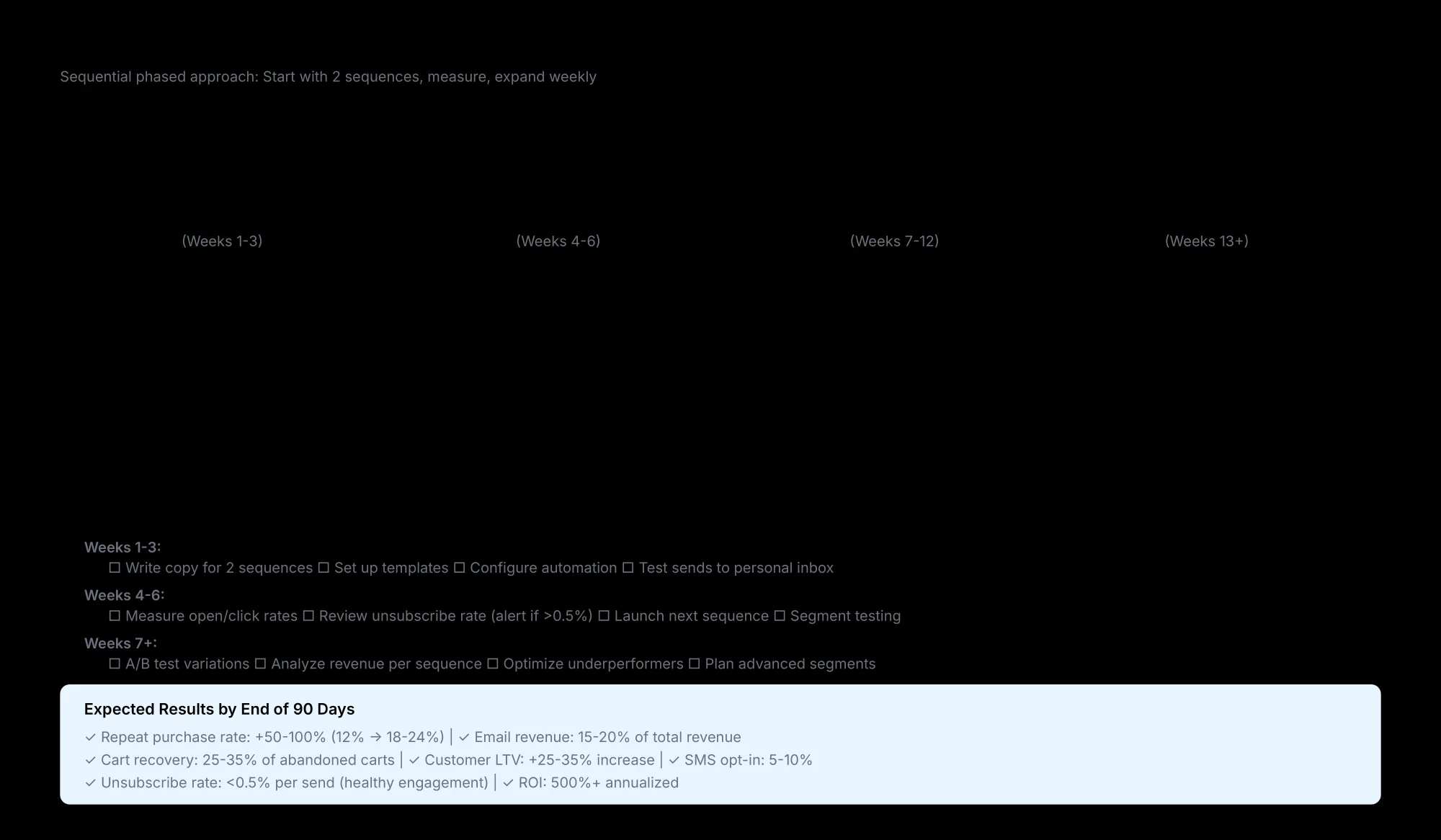
Phase 1: Foundation (Weeks 1–3)
Week 1:
- [ ] Audit current email/SMS setup (what's in place? what's missing?)
- [ ] Document customer lifecycle (days to repeat purchase, average repeat value)
- [ ] Identify quick wins (abandoned cart? win-back? post-purchase?)
Week 2:
- [ ] Set up Shopify Email (if not already)
- [ ] Set up Shopify SMS Channels (if SMS is priority)
- [ ] Request email list opt-in audit (ensure compliance)
- [ ] Design email templates (header, footer, brand colors)
Week 3:
- [ ] Write welcome sequence copy (5 emails)
- [ ] Write abandoned cart sequence copy (3 emails)
- [ ] Create A/B test variations for subject lines
- [ ] Set up automation rules in Shopify
Deliverable: Welcome + abandoned cart sequences live
Phase 2: Expansion (Weeks 4–6)
Week 4:
- [ ] Write post-purchase sequence copy (6-7 emails)
- [ ] Create product recommendation logic (cross-sell/upsell)
- [ ] Set up browse abandonment (if using apps like Omnisend or Klaviyo)
Week 5:
- [ ] Launch post-purchase sequence
- [ ] Set up SMS for high-value triggers (abandoned cart >$150, VIP, reactivation)
- [ ] Write SMS copy for win-back campaign
Week 6:
- [ ] Launch win-back campaign (email + SMS)
- [ ] Measure performance: open rates, click rates, conversion rates
- [ ] Optimize based on early data
Deliverable: 3 sequences live (welcome, abandoned cart, post-purchase), initial SMS campaigns
Phase 3: Optimization (Weeks 7–12)
Weeks 7–8:
- [ ] Analyze segment performance (which segments convert best?)
- [ ] Refine copy based on open/click rate data
- [ ] A/B test discount amounts (10% vs. 15% vs. 20%)
Weeks 9–10:
- [ ] Implement VIP/loyalty escalation sequence
- [ ] Set up browse abandonment (if not yet)
- [ ] Analyze SMS performance: opt-in rate, conversion, CAC
Weeks 11–12:
- [ ] Full performance review
- [ ] Calculate ROI by sequence
- [ ] Plan Phase 4 (advanced segmentation, predictive sends, etc.)
Deliverable: 5 sequences live, SMS integrated, data-driven optimization underway
Expected Results by End of Phase 3
- Repeat purchase rate: +50-100% (12% → 18-24%)
- Email revenue: 15-20% of total revenue
- SMS revenue: 20-30% of email revenue
- Unsubscribe rate: <0.5% per send
- Cart abandonment recovery: 25-35% of abandoned carts recovered
- Customer LTV: +25-35% vs. baseline
FAQ
Should I use Shopify Email or Klaviyo?
Shopify Email if: Sub-$2M ARR, simple sequences, cost-conscious, basic segmentation is enough
Klaviyo if: $2M-10M+ ARR, complex segmentation, predictive analytics, agency support needed
For most Shopify merchants, Shopify Email is sufficient through $2M ARR.
How often should I email customers?
1-3 emails per week is standard. More than 3/week spikes unsubscribe rates. Segment so customers only get relevant emails (if customer didn't buy apparel, don't send apparel emails).
What's the ideal email subject line length?
35-50 characters. Shorter = higher open rates on mobile (where 70% opens happen).
Should I automate SMS or keep it manual?
Automate core sequences (welcome, abandoned cart, win-back). Keep SMS tactical/manual for flash sales, inventory alerts, VIP perks. Too much automated SMS = opt-outs.
How do I reduce unsubscribes?
- Segment aggressively (only send relevant emails)
- Reduce frequency (aim for 1-2/week, not 5-6)
- Offer preference center (let customers choose frequency/categories)
- Prioritize value over offers (70% content, 30% promotional)
What's the best day/time to send email?
Tuesday-Thursday, 10am-2pm (recipient timezone) performs best. But test your audience. A/B test send times.
Can I buy an email list?
Not recommended. Purchased lists have high bounce rates, spam complaints, compliance risks. Build your own through popups, contests, referral programs.
How do I handle SMS opt-in?
Offer incentive (10% off for SMS signup). Be explicit: "Text SHOP to [number] to get alerts, offers, and exclusive updates." Get written consent. Honor unsubscribe immediately.
Conclusion
Email and SMS retention sequences are the closest thing to "free money" in e-commerce.
For a $500K/month store, implementing the six core sequences (welcome, abandoned cart, post-purchase, browse recovery, win-back, VIP) adds $250-400K/year in incremental revenue. The cost: zero (Shopify Email is free) to $500/month (SMS). ROI: 500–5,000x.
The sequences outlined above aren't new. They're proven across millions of e-commerce stores. What's new in 2026 is that Shopify's native tools are good enough that you don't need expensive third-party platforms to execute them well.
Start with welcome + abandoned cart. Measure for 4 weeks. Add post-purchase next. Within 12 weeks, you should have all six sequences running.
Then measure, optimize, and let repeat revenue compound.
Next step: Audit your current email setup. Which sequences are missing? Start there. Pick one sequence, write the copy, launch it, measure. Repeat weekly.
For merchants serious about scaling revenue without proportional ad spend, retention sequences are the lever.