TL;DR: PWAs cost 50-70% less to build than native apps and share a single codebase across platforms, but native apps still deliver 2x higher push notification engagement and 15-20% faster rendering. PWA conversion rates have reached 85-90% of native app levels, up from 60% in 2022. The right choice depends on your store size, customer retention patterns, and revenue stage not which technology is universally "better."
Part of the ShopifyLift Series
Start here: The Shopify Growth Guide 2026: Key Strategies and Trends Every Merchant Should Know
Related deep dives:
Key Takeaways
- Mobile devices account for 55.9% of global web traffic as of March 2026.
- Only 3.5% of mobile sites and 3.3% of desktop sites have built a complete PWA (one with both a web app manifest and a service worker).
- Businesses with fewer than 500,000 monthly mobile visitors should start with PWA.
- PWA conversion rates have reached 85-90% of native app levels, up from 60% in 2022.
- Native apps consistently outperform mobile web: driving up to 3× higher conversion rates and stronger repeat behavior over time.
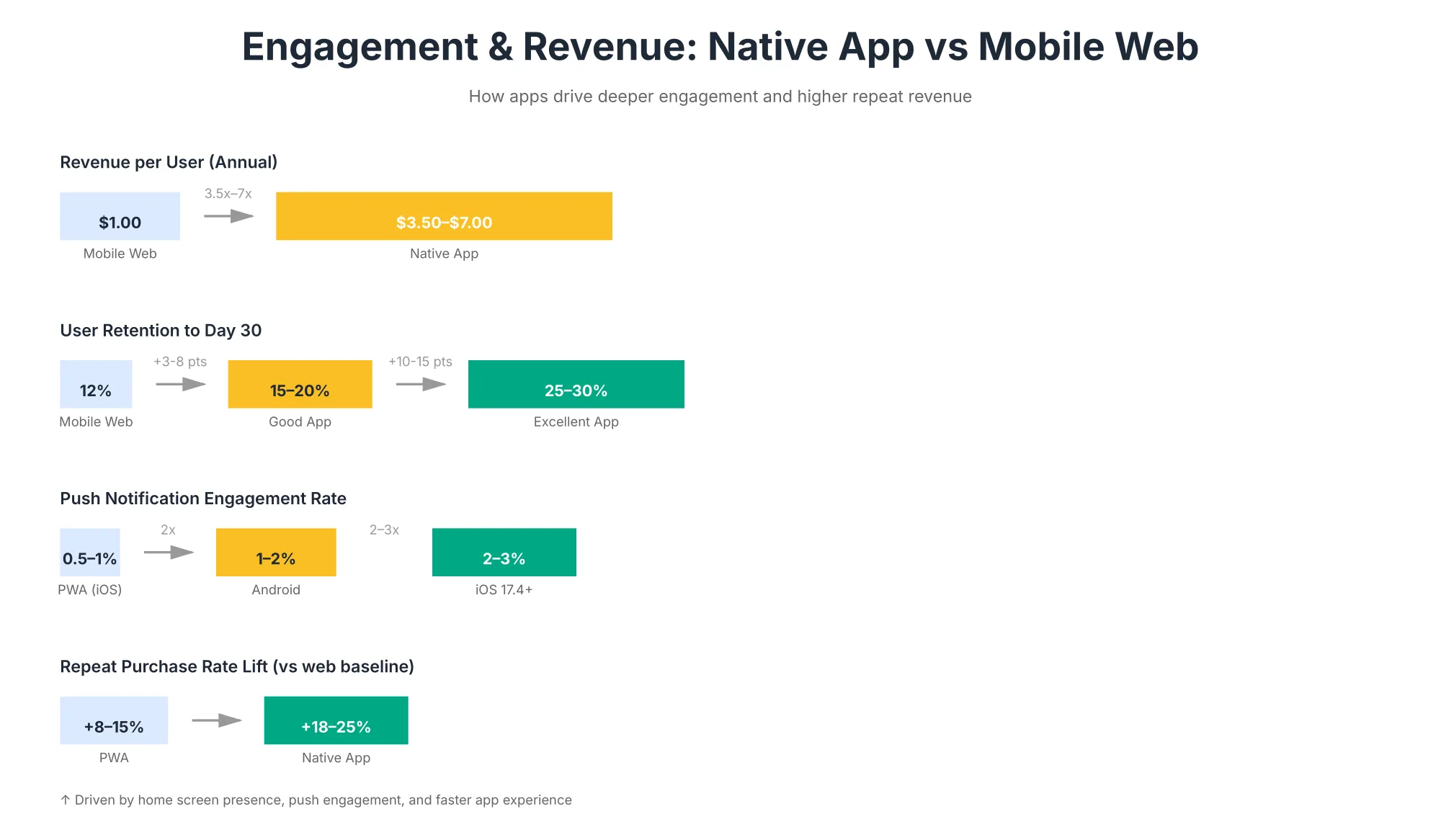
- Mobile apps generate 3.5–7x more revenue per user than mobile web visitors for e-commerce brands, yet over 70% of apps fail to retain users beyond day 30.
- Mobile commerce now drives over 70% of ecommerce traffic and over 44% of total U.S. ecommerce sales.
- Mobile commerce generated approximately $2.5 trillion globally in 2025, accounting for nearly 60% of all retail ecommerce sales, projected to exceed $2.7 trillion in 2026.
- Hybrid strategies (PWA for acquisition, native app for retention) are increasingly common.
The Inflection Point: Why This Choice Matters Now
For the past five years, the PWA vs native question felt academic. Most Shopify stores were neither here nor there they had a mobile website that worked, some email flows, and paid ads keeping them afloat.
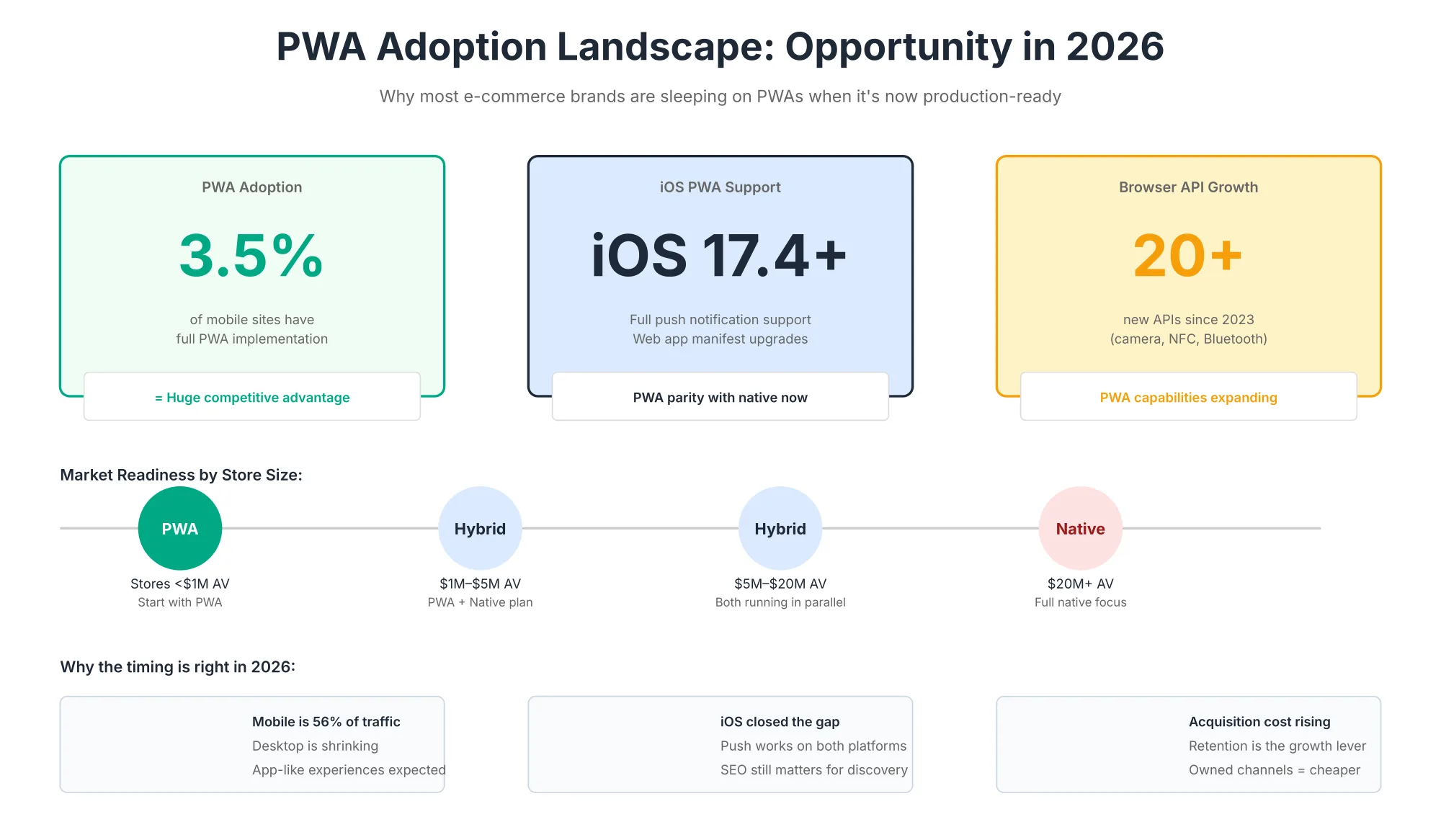
That's breaking down.
Mobile is no longer just a channel. It's the storefront. Mobile commerce grew over 21% year-over-year in 2025, significantly faster than ecommerce as a whole. At the same time, acquisition costs rise and paid channels fragment, retention, repeat purchase, and owned channels are where growth is won.
This creates a fork in the road for Shopify brands:
Path 1: PWA - Fast to launch, low cost, good conversion, no app store gatekeeping. But lower push engagement and harder to go viral.
Path 2: Native App - Higher retention, 2x push notification engagement, deeper device integration, app store presence. But costs 3-5x more and takes 3-6 months to launch.
The mistake most brands make is picking based on technology preference instead of their business reality. This guide helps you think like a merchant, not a developer.
What Actually Is a PWA? (And Why It's Better Than You Think)
A Progressive Web App is a website that behaves like a native mobile app. It loads instantly, works offline, sits on the customer's home screen, and sends push notifications, all without requiring a download from the App Store.
Here's how it works:
A traditional Shopify storefront, even a fast, responsive one, has structural limitations on mobile. Pages reload between navigations. The browser refetches assets on every visit. Push notifications are not available outside email. And there is no install prompt, so the customer has to remember your URL.
A PWA changes this with three technologies:
1. Service Workers (The Cache Layer)
Background scripts that cache your store's assets locally on the customer's device. The first visit downloads everything once; every subsequent visit loads from cache in under a second.
Impact: Pages load in <300ms on repeat visits. Conversion lift: 2-4%.
2. App Shell Architecture (The Skeleton)
The UI loads instantly while content fills in behind it. Customers see your brand and navigation immediately, not a blank white screen.
Impact: Feels native-like. Reduces perceived wait time. Improves perceived performance even if actual load time is the same.
3. Web App Manifest (The Install Trigger)
A small configuration file that tells the device this site can be installed. Customers see an Add to Home Screen prompt, and your store gets a real app icon, splash screen, and full-screen experience.
Impact: One-tap home screen install. No App Store. No gatekeeping.
Additional PWA Capabilities (2026)
Key PWA capabilities in 2026 include: Offline mode via service worker caching, Push notifications (full support on Android, improving on iOS since iOS 17.4), Home screen installation with custom splash screens, Background sync for data updates, Web Share API for native sharing integration, Payment Request API for streamlined checkout, Web Bluetooth and NFC access (limited but expanding).
What Is a Native App? (And What You're Actually Paying For)
A native app is built specifically for iOS or Android using the platform's native language (Swift for iOS, Kotlin for Android) or a cross-platform framework like React Native or Flutter.
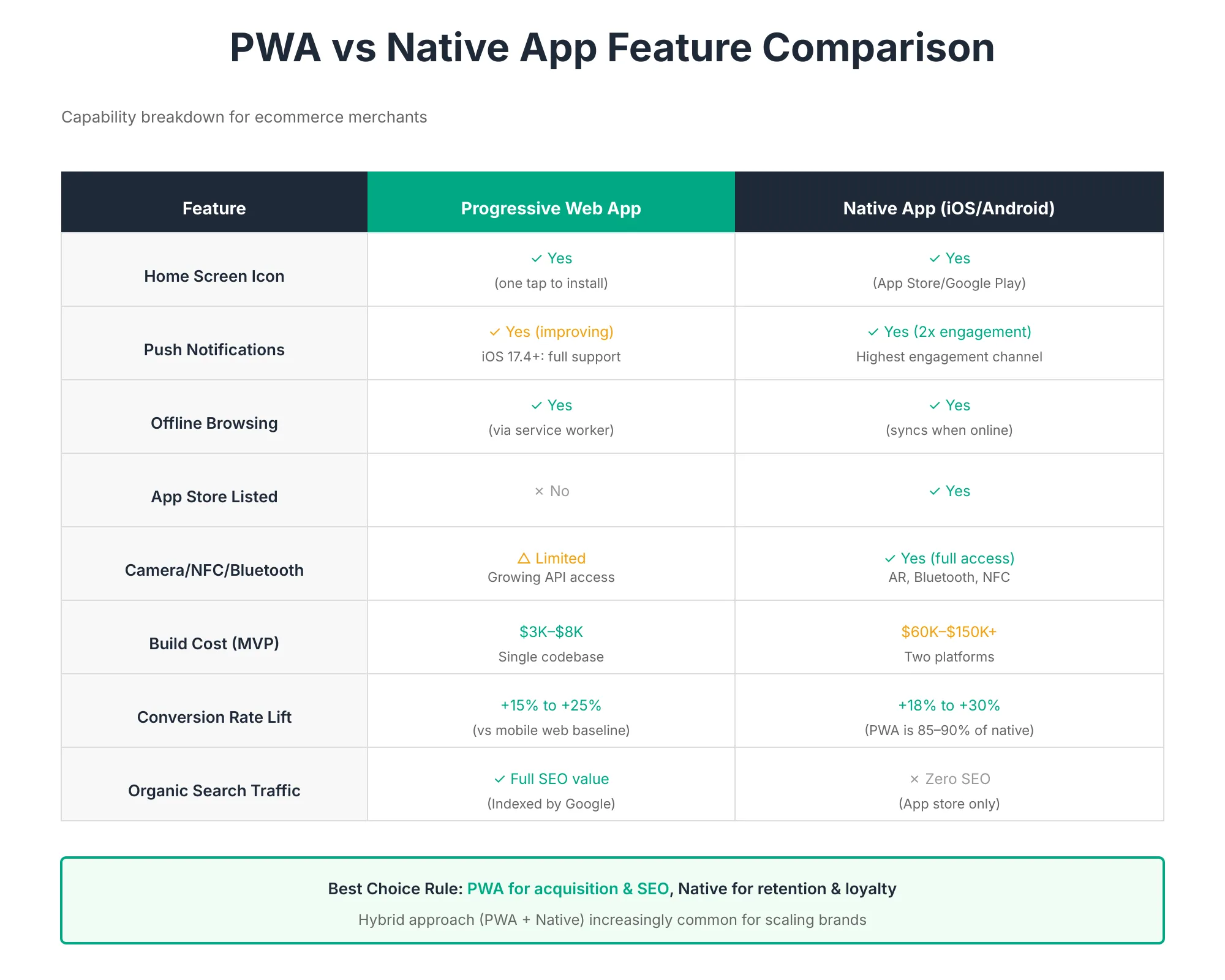
Native apps are distributed through the App Store (iOS) or Google Play (Android). Users download it, install it, and get app-specific features: deep linking, background notifications, device hardware access (camera, contacts, location), offline functionality with synced data, and app-specific analytics.
The catch: You're building for two platforms, which means two codebases, two teams, or one team working twice as hard.
The Numbers: PWA vs Native (2026)
Development Cost
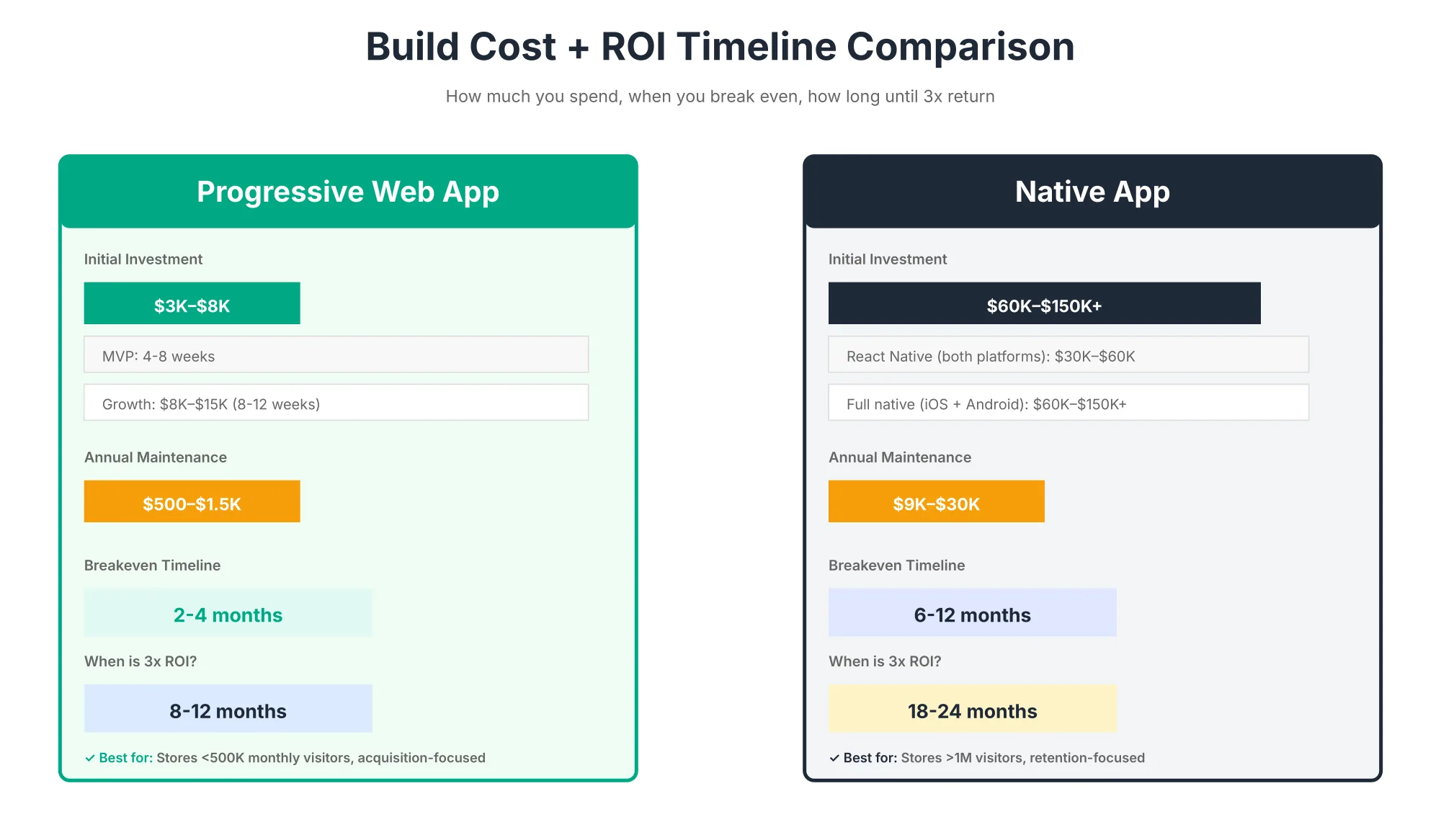
PWAs cost 50-70% less to build than native apps and share a single codebase across platforms.
Typical costs:
| Approach | Complexity | Cost Range | Timeline |
|---|---|---|---|
| PWA | MVP | $3,000–$8,000 | 4–8 weeks |
| PWA | Growth-stage | $8,000–$20,000 | 8–12 weeks |
| React Native (both platforms) | MVP | $15,000–$30,000 | 6–12 weeks |
| React Native (growth) | Growth-stage | $30,000–$60,000 | 12–16 weeks |
| Native (both iOS + Android) | Growth | $60,000–$150,000+ | 16–24 weeks |
Translation for Shopify merchants: A PWA to match your website costs ~$8K–$15K. A native app costs $60K–$150K+. A hybrid approach (PWA + React Native) costs $25K–$50K total.
Performance: Conversion & Speed
PWA conversion rates have reached 85-90% of native app levels, up from 60% in 2022.
What this means: If a native app converts at 3% on mobile, a PWA will convert at 2.55–2.7%. The gap has nearly closed.
Native apps still deliver 2x higher push notification engagement and 15-20% faster rendering.
Translation: Native is faster to render (important for high-friction categories like luxury goods). Push notifications hit 2-3% engagement on native vs 0.5–1% on PWA.
User Retention
Mobile apps generate 3.5–7x more revenue per user than mobile web visitors for e-commerce brands, yet over 70% of apps fail to retain users beyond day 30.
This is the real native advantage. Native apps give you:
- Home screen presence (constant reminder)
- Push notification capability (direct re-engagement)
- Offline functionality (works when user is on the subway)
- App-specific analytics (deeper behavior tracking)
But it's not the technology that drives retention it's the marketing funnel. Most brands launch apps without a retention strategy and watch 70% of users churn by day 30.
SEO Impact
PWA: PWAs are still websites and are indexed normally by Google. You keep organic traffic, internal linking equity, and SEO value.
Native app: Zero organic traffic. Zero SEO. You're starting retention from zero only paid acquisition, push notifications, and email matter.
Decision Framework: When to Choose PWA vs Native
Choose PWA If:
Store size: <500,000 monthly mobile visitors
- PWA ROI breaks even faster
- Development cost low enough that first-year revenue uplift pays for it
Customer acquisition dominates over retention
- You're competing on discovery
- SEO and paid acquisition are your growth levers
- First-time buyer economics matter more than repeat customers
You haven't optimized mobile web yet
- If conversion on mobile web is weak, fix that first
- Add PWA once your responsive website meets Core Web Vitals targets and is converting
- PWA amplifies a good experience; it doesn't fix a bad one
Your repeat purchase rate is <20% of revenue
- Repeat customers exist but aren't the growth driver
- New customer acquisition is still the priority
- Push notifications would be nice but aren't critical
You want to start small and learn
- PWA is your test kitchen
- Build it, measure retention, track repeat purchases
- If metrics support native (>30% repeat, >15% retention to day 30), upgrade to native
- Lower risk, lower cost, lower commitment
Real example: A subscription box company with 300K monthly mobile visitors, 25% first-purchase conversion, 35% repeat purchase rate. PWA fits because: (1) site size doesn't justify $100K native build, (2) repeat customers exist but aren't the sole focus, (3) SEO matters (discovery is important), (4) wants to test app experience before committing to native.
Choose Native App If:
Store size: >1 million monthly mobile visitors
- ROI becomes positive faster
- App development cost is 2-3% of annual mobile revenue
- Retention gains compound quickly at scale
Repeat purchase drives 40%+ of revenue
- Your best customers buy 3+ times per year
- LTV optimization is the growth lever
- Home screen presence and push notifications are table stakes
Push notifications are a core retention channel
- You've proven 3%+ engagement with email
- Push could add 1-2% to repeat purchase rate
- Owned channel matters more than paid acquisition
Your customer LTV supports the investment
- $100K app development is worth it if it drives $300K in incremental repeat revenue
- Typical payback: 6-12 months for retention-focused brands
App store presence creates competitive advantage
- Luxury brands, subscription boxes, membership programs
- "Available on App Store/Google Play" signals legitimacy
- Some customers expect an app
Device hardware features unlock value
- AR try-on (luxury fashion)
- Bluetooth for connected products
- Camera integration (photo uploads)
- Offline mode for field sales
Real example: A beauty subscription box with 2M monthly mobile visitors, 65% repeat purchase rate, $85 average LTV. Native app makes sense because: (1) store size justifies $80K investment, (2) retention is the business model, (3) push has proven 2.5% engagement with existing email list, (4) AR try-on for makeup can be a differentiator.
The Hybrid Strategy: PWA + Native App
Hybrid strategies (PWA for acquisition, native app for retention) are increasingly common.
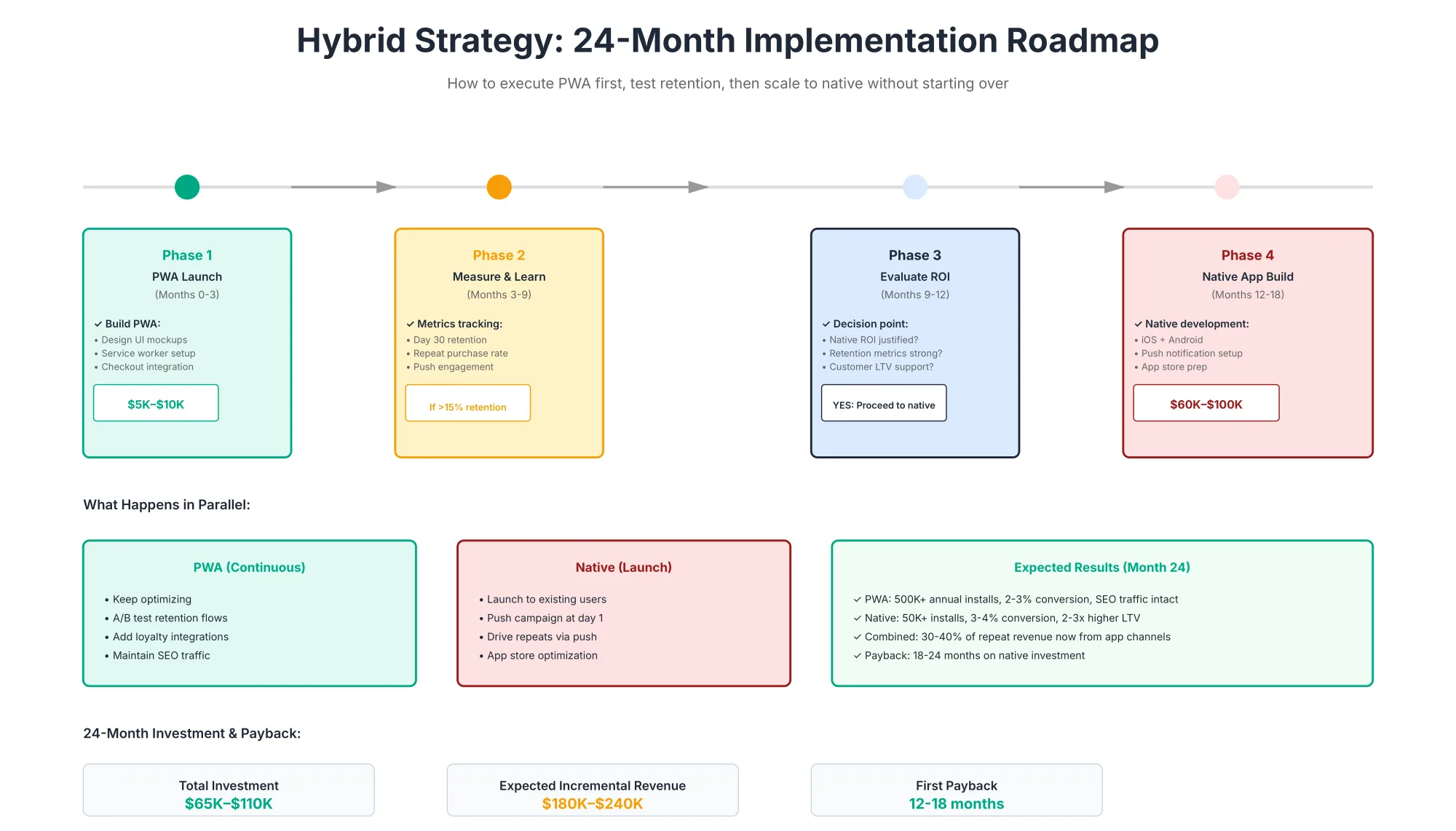
This is increasingly the right move for growing brands:
Phase 1 (Months 0-6): Launch PWA
- Cost: $8K–$15K
- Goal: Test mobile app experience, measure retention, gather data
- Collect metrics: install-to-purchase rate, push engagement, repeat purchase lift
Phase 2 (Months 6-12): Evaluate native app ROI
- If repeat purchase jumps >30%, native app is worth it
- If retention to day 30 crosses 15%, native app makes sense
- Run the math: incremental revenue vs $80K investment
Phase 3 (Months 12+): Build native for your core audience
- Use repeat customer segment for initial app store optimization
- Target app ads to existing customers (LTV is high)
- Use PWA to continue acquiring new customers (SEO, organic)
Result: PWA handles acquisition + new customer onboarding. Native app deepens retention for best customers. You get the SEO and discovery benefits of web plus the retention superpowers of native.
Common Mistakes (And How to Avoid Them)
Mistake #1: Building an App Without a Retention Strategy
The problem: You launch an app. It has zero push notification strategy. No email sequence welcomes new app users. No loyalty program. Users install, browse once, and churn.
The fix: Plan your retention funnel before you build:
- Day 0-1 onboarding (what's the first compelling action?)
- Day 3 re-engagement push (special offer or personalized recommendation)
- Day 7 loyalty trigger (sign them up for rewards)
- Day 30 win-back campaign (if they're not using it, why?)
Without this, your app is just a slower website.
Mistake #2: Choosing PWA or Native Based on Technology Preference
The problem: Developer says "PWA is the future!" or "We have to go native!" Decision made. Budget allocated. Six months in, metrics don't support the choice.
The fix: Start with the numbers:
- What's your monthly mobile traffic?
- What's your repeat purchase rate?
- What's your current push notification engagement?
- What's your customer LTV?
These four numbers decide your path. Not technology opinion.
Mistake #3: Launching a Native App Without Acquisition Strategy
The problem: You spend $100K on a native app. Day 1 launches to 10 users (your internal testers). App store algorithm doesn't know about it. You have no organic app store traffic. Zero growth.
The fix: Plan app store optimization before launch:
- Optimize app store listing (keywords, screenshots, description)
- Build pre-launch waitlist (capture emails now, notify when app launches)
- Day 1 push campaign to existing customers (install + first purchase incentive)
- Paid app install ads ($1-3 per install for e-commerce apps)
App store discovery is worse than Google search. Plan for paid acquisition from day 1.
Mistake #4: Not Optimizing Your Mobile Web First
The problem: Your mobile web converts at 1.2%. You build a PWA. It converts at 1.5% (PWA improvement: 25%). Still low. You blame the technology.
The fix: Before PWA or native, fix mobile web:
- Core Web Vitals optimized (LCP <2.5s, INP <200ms, CLS <0.1)
- Checkout streamlined (1-page, guest checkout, Shopify Pay)
- Product pages optimized (clear images, reviews, trust badges)
- Navigation clear (mega menu, faceted search)
A PWA amplifies a 3% conversion rate to 3.2-3.4%. But it won't fix a 1% conversion rate. Mobile web is the foundation.
The Shopify Mobile Strategy: Past, Present, Future
2020: React Native was the future. One codebase. Both platforms. Lower cost than native.
2024-2025: React Native worked well for most use cases. Shopify's own mobile app was built on it.
September 2026: Shopify moved back to separate Swift and Kotlin codebases for their native apps, because agents can now do enough of the implementation, translation, testing, and review work that it's no longer the deciding factor it was in 2020.
Translation: Shopify the company that best understands Shopify merchant needs, decided native is worth the investment again. This signals the ROI math for retention-focused brands is strong.
But this doesn't mean React Native is dead. In 2026, Flutter and React Native are the default choice for almost every business app performance is indistinguishable for typical products. Go native only when you genuinely need it: heavy graphics, unusual hardware access, platform-first experiences.
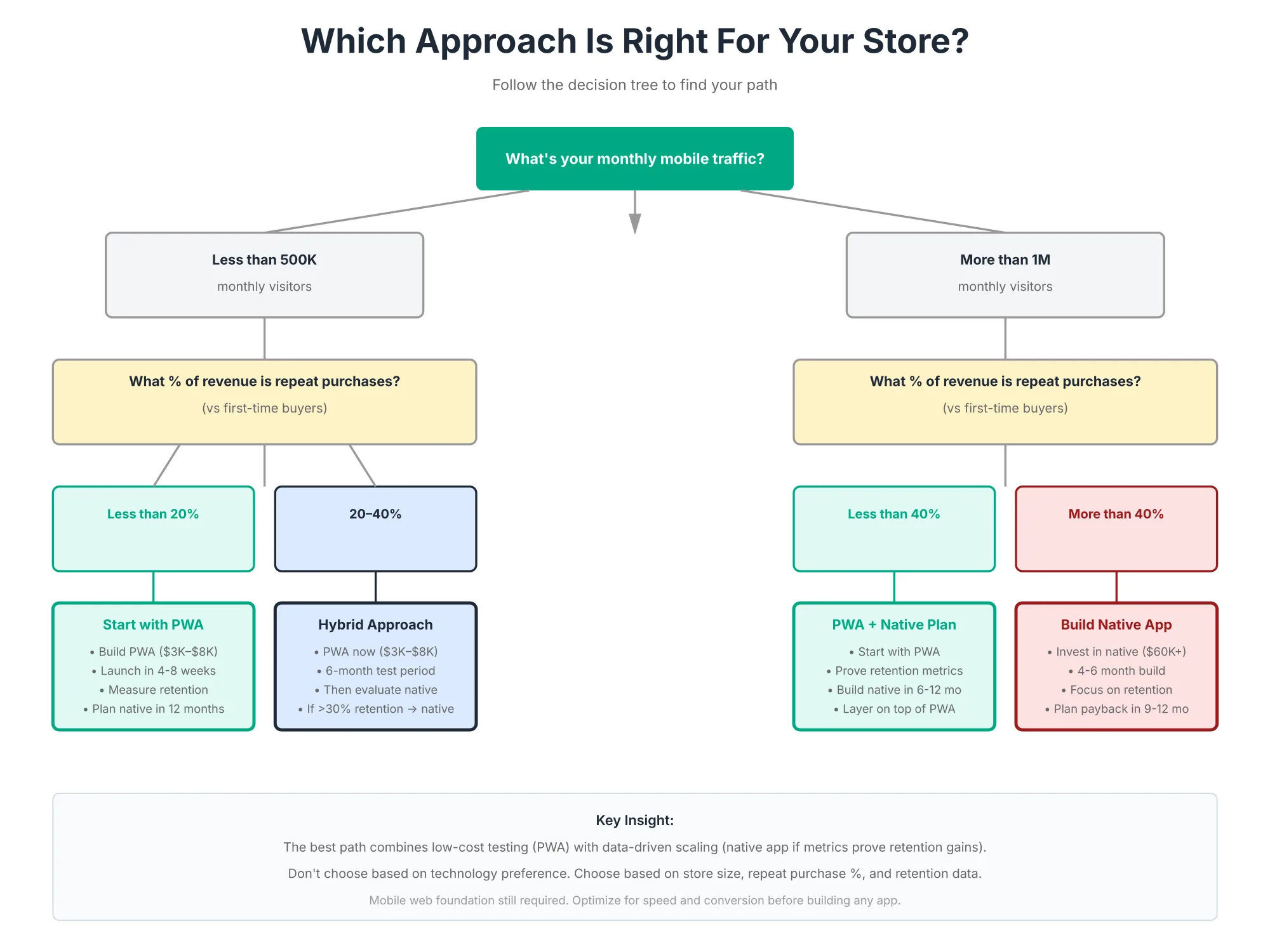
The Decision Tree (Simple Version)
Q1: What's your monthly mobile traffic?
- <500K → PWA first
1M → Consider native
Q2: What % of revenue is repeat purchases?
- <20% → PWA
- 20-40% → Hybrid (PWA now, native in 12 months)
40% → Native
Q3: Have you optimized mobile web yet?
- No → Fix mobile web first (1-2 months), then PWA
- Yes → Move to PWA or native per above
Q4: Do you have a retention funnel planned?
- No → Plan it now (email, push, loyalty), then build app
- Yes → Build app, execute retention, measure LTV lift
The Merchant Math: When Does Native ROI Break Even?
Scenario: DTC brand with $2M annual revenue, 60% mobile traffic
Investment: Native app build = $80,000
Timeline: 6 months to launch, 2 months to get real traction = 8 months total
Expected results (conservative):
- Day 30 retention improves from 12% to 18% (6 percentage points)
- This means repeat purchase rate lifts from 35% to 41% (6 percentage points × average repeat LTV)
- Incremental repeat revenue: $2M × 60% mobile × (41% - 35%) / 6 months = $40K first 6 months
- Annual run rate: $120K incremental revenue
Payback calculation:
- $80K investment ÷ $120K annual incremental revenue = 0.67 years = 8 months payback
- Lifetime value (assuming 3-year payback window): $360K revenue from one $80K investment
This is why retention-focused brands invest in native apps. Payback is faster than most marketing channels.
The Reality Check: App Success Rates
Over 70% of apps fail to retain users beyond day 30.
This is the critical number. It means:
- Your app is beautiful? 70% of users churn anyway
- Your app is fast? 70% churn
- Your app is native? 70% churn (unless you have a retention strategy)
The technology matters less than the funnel. A mediocre app with a strong onboarding + push + loyalty sequence beats a beautiful app with no retention plan.
Connecting to Your Shopify Growth Strategy
In the hub-and-spoke model:
- Spoke #1 (AI Discovery) - Gets you discovered
- Spoke #2 (TikTok Shop) - Brings impulse shoppers
- Spoke #3 (CRO) - Converts visitors to buyers
- Spoke #4 (Loyalty) - Turns buyers into repeat customers
- Spoke #5 (Checkout Extensibility) - Unlocks post-purchase upsells
- Spoke #6 (PWA/Native) ← YOU ARE HERE - Gives repeat customers a dedicated channel
- Spokes #7-10 - Scale internationally, through email/SMS, and optimize everything
A PWA or native app is the home for your repeat customers. It's where loyalty programs live, where push campaigns drive engagement, where the repeat purchase funnel accelerates.
Frequently Asked Questions
Q: Can I launch both PWA and native app at the same time?
A: No. You'll split focus, burn budget, and execute neither well. PWA first (2-3 months), measure, then native (if metrics support it) at 6-12 months.
Q: What if Shopify adds PWA tools to the admin?
A: They likely will. That would lower PWA costs further and make it the default choice for mid-market stores. This reinforces the "PWA first" strategy.
Q: What about using an app builder (MobiLoud, Tapcart, etc.) instead of building custom?
A: These are excellent for mid-market stores ($1M–$10M revenue). They handle the infrastructure, push setup, analytics. Cost: $500–$3K/month. ROI: faster time-to-value, less technical debt, easier to scale.
Q: If I build a PWA, can I convert it to a native app later?
A: Some code reuse is possible, but a native app is a rebuild, not a port. Budget separately for native. Think of PWA as a test ($10K), native as the production version ($80K).
Q: What about App Clips (iOS) or App Shortcuts (Android)?
A: These are lightweight alternatives. They work for one specific flow (like checkout or loyalty redemption). Not a replacement for PWA or native.
Q: How do I know if my app retention is good?
A: Benchmark: If you're at 15%+ retention to day 30, your app is better than 70% of e-commerce apps. If you're >25%, your retention funnel is working well. Track it weekly.
What Not to Do
Don't build an app without a landing page strategy. App store discovery is terrible. Plan for email, paid ads, or website prompts to drive installs.
Don't launch without a day-1 push sequence. If your app sits silent on a user's home screen, they'll delete it in a week.
Don't choose based on technology opinion. Let the numbers decide. <500K mobile visitors + <20% repeat = PWA. >1M visitors + >40% repeat = native.
Don't forget maintenance costs. Budget 15-20% of build cost annually for updates, app store compliance, and bug fixes.
Don't ignore the App Store algorithm. Even a perfect app will get zero traction without reviews, rating, and regular updates. Plan for ongoing optimization.
This guide reflects 2026 PWA and native app realities based on data from Shopify merchant benchmarks, Ecosire, MobiLoud, Tapcart, and ecosystem partners.