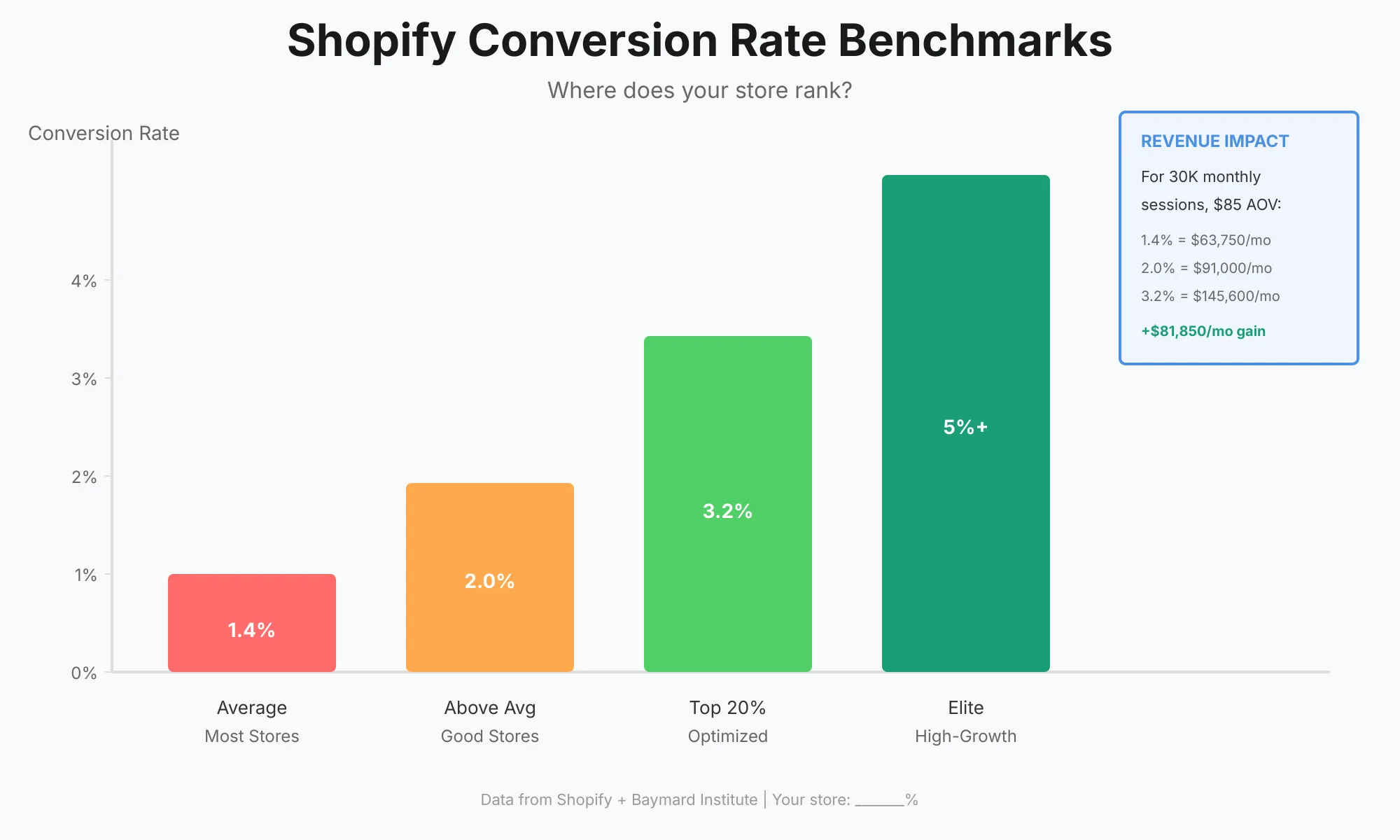
TL;DR: Most Shopify stores convert only 1.4% of visitors into customers, while the top 20% of performers hit 3.2% or higher. That gap represents thousands of dollars in revenue for the same amount of traffic. Conversion Rate Optimization (CRO) is the highest-ROI activity you can pursue because instead of spending more on ads, CRO helps you improve the shopping experience so more existing visitors actually convert into customers. This guide covers the friction points that leak revenue, how to fix them, and the exact metrics to track.
Part of the ShopifyLift Series
Start here: The Shopify Growth Guide 2026: Key Strategies and Trends Every Merchant Should Know
Related deep dives:
Key Takeaways
- The average Shopify store converts at 1.4%. Anything above 3.2% puts you in the top 20% of performers.
- The average e-commerce cart abandonment rate sits at roughly 70% in 2026, meaning about seven in ten shoppers leave before paying — mobile runs even higher, near 80%.
- Unexpected shipping costs are the leading cause of cart abandonment at 48%, followed by forced account creation at 25%, and long or confusing checkout at ~18%.
- Removing one form field, adding one trust badge, or pre-filling one address line each contribute 0.5-2 percentage points. Stack five of them and you've added 5-10 points.
- A typical Shopify store with 30,000 monthly sessions, 2.5% conversion, and $85 AOV sees ~$148,750/month in abandoned checkout revenue at a 50% checkout abandonment rate.
- Free-shipping thresholds with progress visualization routinely lift AOV 8-15%.
Why CRO Is the Highest-Leverage Growth Activity
Before you spend another dollar on ads, understand this: getting traffic to your Shopify store is already expensive. So when shoppers browse products, add items to cart and still leave without buying, it feels less like a traffic problem and more like money quietly leaking out of your business.
Every marketing dollar you spend brings traffic to your store. But traffic is only half the equation. Conversion is where that traffic becomes revenue.
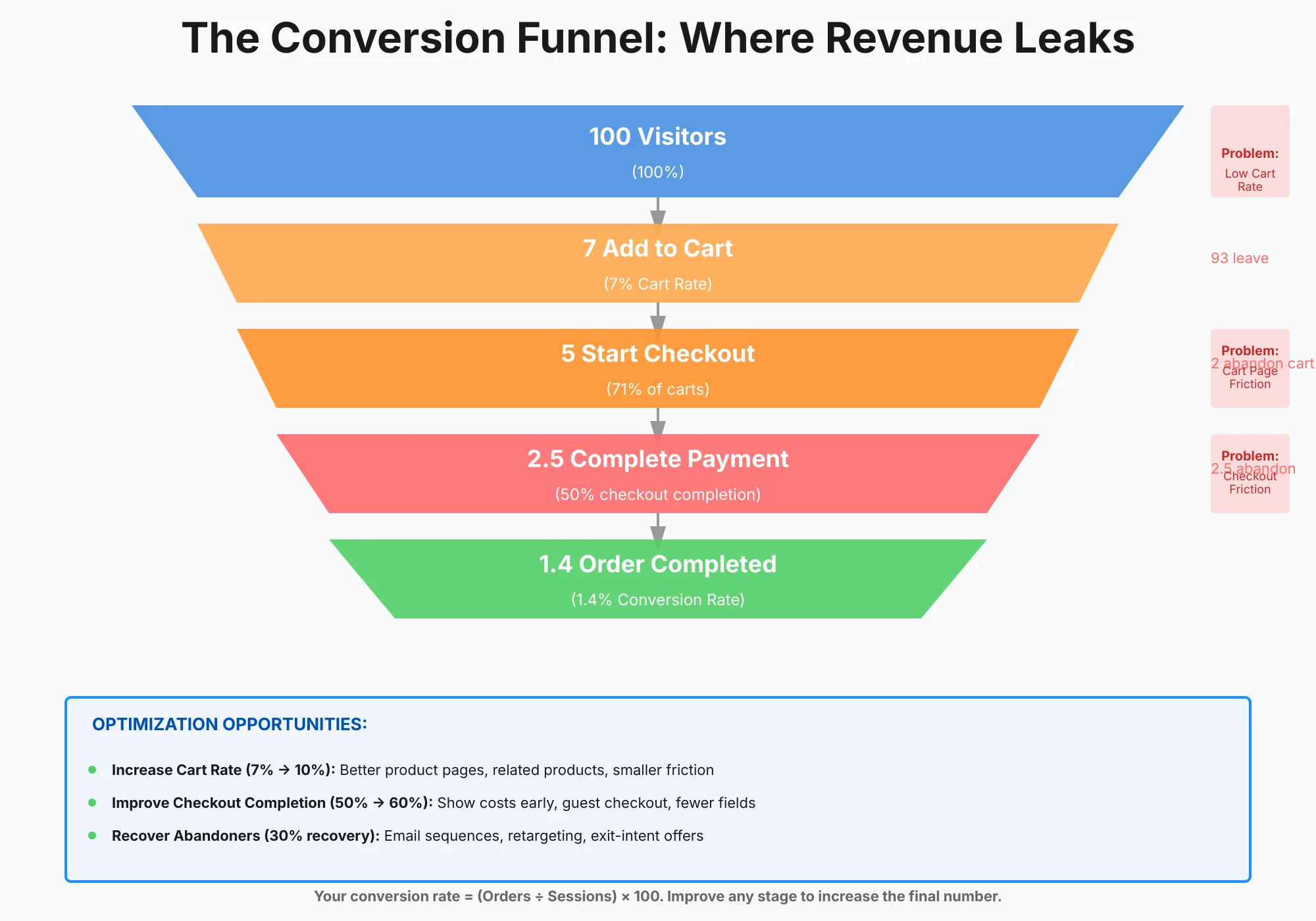
A typical conversion funnel looks like this:
- 100 visitors land on your store
- 7 add something to cart (7% cart rate)
- 5 start checkout (71% of those who added to cart)
- 1.5 complete purchase (30% checkout completion)
- 1.4 becomes real revenue (accounting for refunds)
The math is brutal: to get 1 paying customer, you need ~100 visitors. But here's the opportunity: if you could move that 1.4 to 2.5 without changing traffic, you've increased revenue by 78% with zero additional marketing spend.
That's why CRO is often the highest-ROI activity you can pursue. Traffic is expensive. Converting more of the traffic you already have is not.
The CRO Mindset: What NOT to Do
In 2026, merchants are waking up to the fact that aggressive CRO tactics don't work anymore.
In the past, merchants applied obvious, aggressive tactics such as adding countdown banners and pop-ups. However, it's becoming more and more challenging to meet the CRO benchmark on Shopify. Consumers are getting more conscious of intrusive sales tactics.
Here's what modern CRO is NOT:
Forcing sales at all costs — Fake limited-time banners, fabricated urgency, and aggressive popups breed distrust. Customers can spot these cheap tactics in seconds.
Only focusing on "buy now" buttons — CRO isn't about button color or placement. The customer journey includes multiple touch points, not just the final click.
Guessing customer behavior — Real CRO uses data and evidence, not hunches. Measure before you optimize.
Modern CRO is about reducing friction, building trust, and creating a seamless experience. Modern online shoppers demand honesty, clarity, and speed. The most effective, sustainable way to build a profitable Shopify business is to create a seamless user experience.
The 7 Biggest Friction Points (and How to Fix Them)
Most abandonment traces back to a handful of fixable friction points at or before checkout. Here are the seven that leak the most revenue:
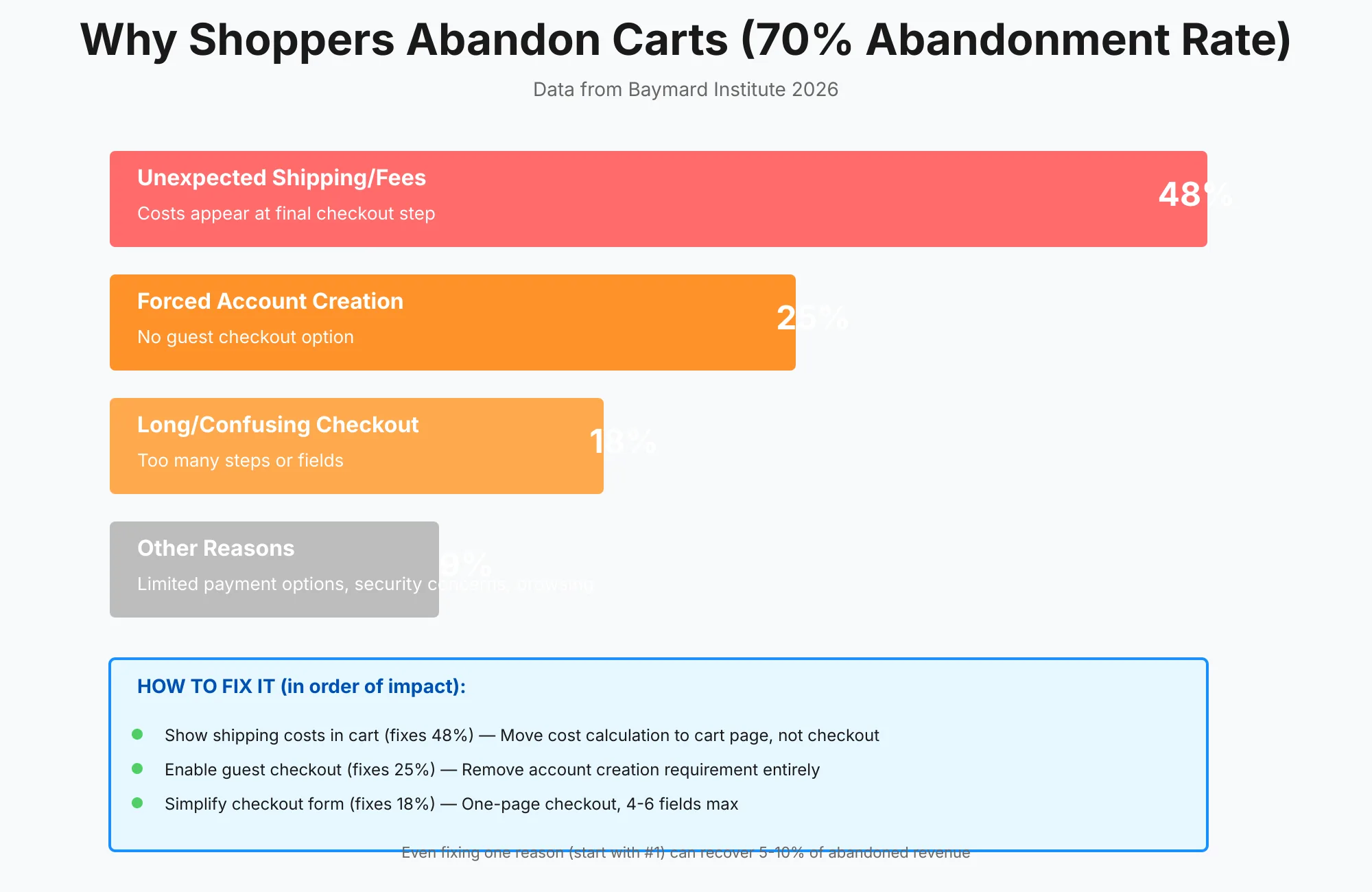
1. Surprise Costs at Checkout (48% of Abandonment)
The Problem: Nearly half of all cart abandonments happen because shoppers encounter unexpected shipping fees, taxes, or surcharges only at checkout. The psychological impact is immediate. It feels like a bait-and-switch, and trust evaporates.
How to Fix It:
- Show shipping cost in the cart — Not at checkout. Use Shopify's built-in shipping calculator to display estimated costs immediately when the customer adds items.
- Set a clear free-shipping threshold — A visual progress bar showing "You're $15 away from free shipping" can lift AOV 8-15%.
- Display all costs upfront — Cart should show: subtotal + estimated shipping + estimated tax = total. No surprises.
- Offer multiple shipping options — Standard, express, overnight. Let customers choose their speed vs. cost tradeoff.
Impact: Fixing hidden costs alone recovers 5-10% of abandoned checkouts.
2. Forced Account Creation (25% of Abandonment)
The Problem: Forced account creation is the second-leading reason for abandonment. Requiring registration before purchase adds friction.
How to Fix It:
- Enable guest checkout — This is non-negotiable. Never require account creation to buy.
- Optional account creation post-purchase — Offer it after the order is placed, not before. The win is already yours; no need to add friction.
- Social login options — Google, Apple, or Meta login can feel faster than filling out a form.
- Pre-fill information when possible — Use first-party data from previous sessions to reduce friction for returning visitors.
Impact: Guest checkout alone recovers 25% of abandoned orders.
3. Long or Confusing Checkout (18% of Abandonment)
The Problem: A typical multi-page checkout takes around 1 minute 40 seconds to complete. One-page checkout trims that to under a minute.
How to Fix It:
- Adopt one-page checkout — All fields visible at once. Progressive disclosure (show/hide) can feel cleaner than multi-step forms. (For advanced checkout optimization and post-purchase upsells, see Checkout Extensibility)
- Ask only for essentials — Name, email, phone, address, payment. Everything else is optional.
- Auto-fill address — Use Shopify's built-in address validation to let customers type and auto-populate.
- Progress indicators — If you must use multi-step, show a clear progress bar so customers know how many steps remain.
Example: Streamlined Checkout Flow
Step 1: Contact Info (Name, Email)
Step 2: Address (with auto-fill)
Step 3: Shipping Method (with costs visible)
Step 4: Payment (Shop Pay, PayPal, card)
Four steps max. Each step under 30 seconds.
Impact: Reducing checkout steps from 5 to 3 can lift completion by 5-7%.
4. Limited Payment Options
The Problem: Shoppers expect multiple payment methods. Forcing them to search for their preferred option causes abandonment.
How to Fix It:
- Shop Pay — Shopify's native one-click checkout. 30-40% faster than card entry.
- Wallets — Apple Pay, Google Pay, PayPal. These are table stakes in 2026.
- Buy Now, Pay Later (BNPL) — Klarna, Afterpay, Affirm. Lifts AOV and lowers cart abandonment.
- Regional payment methods — Depending on your audience: iDEAL (Netherlands), Alipay (Asia), Giropay (Germany).
Pro Tip: Shop Pay + at least one BNPL option covers 80% of payment preferences in most Western markets.
Impact: Adding one payment option can recover 2-4% of abandoned checkouts.
5. Security & Trust Concerns
The Problem: Shoppers are wary of entering payment info on unknown sites.
How to Fix It:
- Display trust badges prominently — SSL certificate, security logos, verified reviews. Place them near the checkout button.
- Show refund policy clearly — A simple, straightforward returns policy builds confidence.
- Display payment logos — Visa, Mastercard, Amex, PayPal logos signal legitimacy.
- Customer reviews & testimonials — Place high-quality reviews, photos, and star ratings on product pages and checkout.
Impact: Adding trust signals can lift conversion by 2-5%.
6. Mobile-Specific Friction
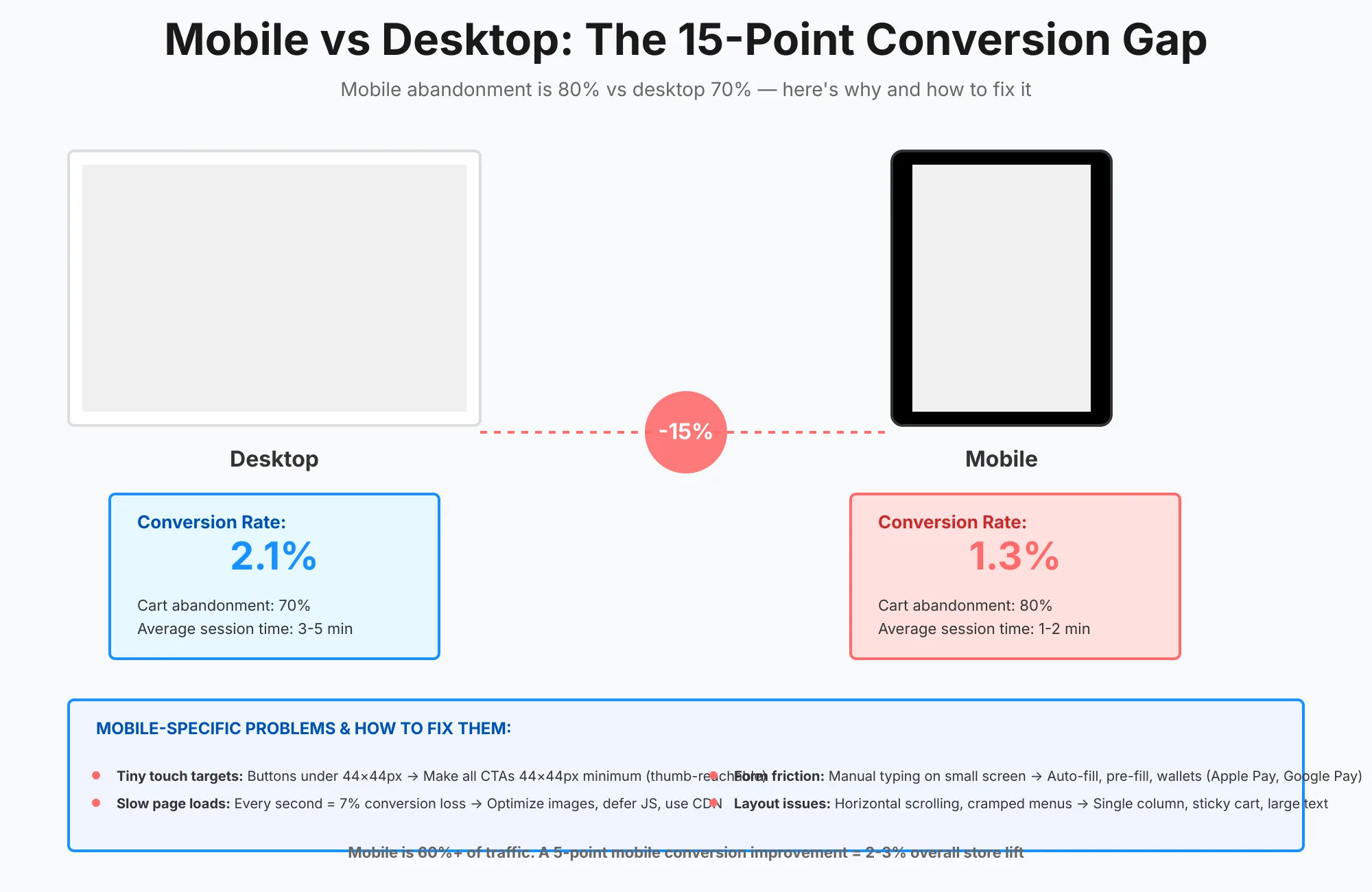
The Problem: On mobile, the cart abandonment rate jumps to 85% — 15 points higher than desktop.
How to Fix It:
- Optimize for thumb — Make buttons large (minimum 44x44 pixels), place CTAs at bottom of screen where thumbs naturally rest.
- Reduce typing — Use biometric payment (Face ID, fingerprint), accelerated wallets, and address auto-fill.
- Fast load times — Every second of delay costs 7% of conversions. Optimize images, defer non-critical JavaScript, and meet Core Web Vitals targets to recover mobile conversions.
- One-hand checkout — Single-column layout, large touch targets, minimal scrolling.
Impact: Mobile optimization alone can recover 10-15% of mobile abandonment (a 2-3% overall store lift).
7. Not Ready to Buy
The Problem: Some shoppers are genuinely just browsing, not intending to buy on this visit.
How to Fix It:
- Abandoned cart emails — Send within 1 hour of cart abandonment, with a reminder of what they left behind. Follow up at 24 hours and 72 hours.
- Retargeting ads — Show the exact product they viewed across Instagram, Facebook, Google.
- Exit-intent offers — A small discount ("10% off your first order") can convert browsers into buyers, but only use this for genuine browsers, not after they've already decided to buy.
Pro Tip: Recover carts by cutting friction, building trust, and re-engaging fast — send the first reminder within an hour of abandonment.
Impact: A good abandoned cart email sequence recovers 10-30% of cart abandonment.
The Four Levers of Checkout Optimization
Every meaningful checkout optimization falls into one of four buckets. Work them in this order and the gains compound: Reduce friction. Build trust. Recover abandoners. Lift order value.
Lever 1: Reduce Friction (Highest Impact)
Friction reduction has the biggest payoff because Shopify's default checkout still has unnecessary steps and fields.
Quick Wins:
- Remove unnecessary form fields (-1% abandonment per field removed)
- Enable guest checkout (-5% abandonment)
- Add address auto-fill (-2% abandonment)
- Show costs in cart (-10% abandonment)
Lever 2: Build Trust (High Impact)
Trust comes second, especially on stores where the brand isn't yet a household name.
Quick Wins:
- Add customer reviews (+3-5% conversion)
- Display security badges (+1-2% conversion)
- Show refund policy (+2% conversion)
- Add trust testimonials (+1-3% conversion)
Lever 3: Recover Abandoners (Medium-High Impact)
Recovery tactics stack on top once the path itself is clean.
Quick Wins:
- Abandoned cart emails (+10-30% recovery)
- SMS follow-ups (higher engagement than email)
- Exit-intent discount (use sparingly, only for genuine browsers)
- Retargeting ads (20-40% ROAS typical)
Lever 4: Lift Order Value (Medium Impact)
Once checkout is clean, increase what each customer spends.
Quick Wins:
- Free-shipping thresholds with progress visualization. A "you're $7 away from free shipping" bar at the top of cart and checkout routinely lifts AOV 8-15%.
- Product bundles in cart (not checkout)
- Frequently-bought-together recommendations
- Shipping protection upsells. A small ($1-3) protection add-on in checkout or cart converts at 20-40% and is nearly pure margin.
CRO Metrics: What to Measure
Before you optimize, establish a baseline. Here are the metrics that matter:
| Metric | Formula | Target | Why It Matters |
|---|---|---|---|
| Conversion Rate | (Orders ÷ Sessions) × 100 | 2-3%+ | Overall store health |
| Cart Rate | (Carts ÷ Sessions) × 100 | 7-10%+ | Product interest level |
| Checkout Start Rate | (Checkouts ÷ Carts) × 100 | 70%+ | Cart page experience |
| Checkout Completion | (Orders ÷ Checkouts) × 100 | 50%+ | Checkout friction |
| Cart Abandonment | ((Carts - Orders) ÷ Carts) × 100 | <70% | Revenue leakage |
| Average Order Value | Total Revenue ÷ Orders | Category dependent | Profit per customer |
| Mobile Conversion | Mobile orders ÷ Mobile sessions | 60-80% of desktop | Mobile-specific issues |
Action Plan:
- Measure your baseline in Shopify Analytics or Google Analytics 4
- Pick the metric with the worst performance
- Implement fixes in that area
- Re-measure after 2 weeks
- Compound the gains
CRO Experiments Worth Running (A/B Testing)
Every tactic has been validated across 70,000+ experiments, with over 1,000 Shopify brands using Omniconvert products to run them.
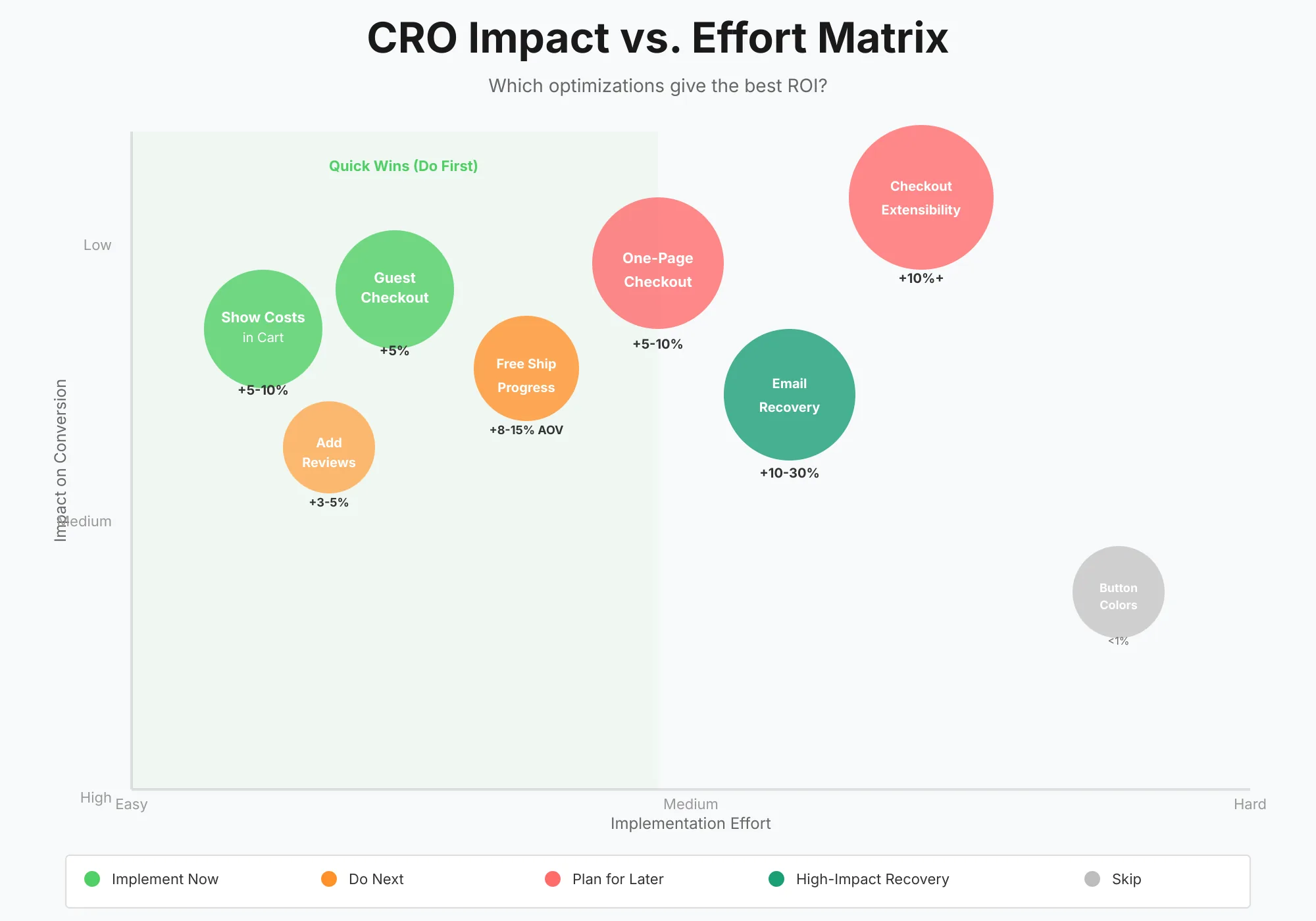
High-Priority Experiments (Start Here)
| Experiment | Expected Lift | Implementation Time | Tools |
|---|---|---|---|
| Remove unnecessary form fields | 2-5% | 30 min | Shopify checkout settings |
| Add guest checkout (if not enabled) | 5-10% | 15 min | Shopify checkout settings |
| Show shipping in cart | 5-10% | 1-2 hours | Shopify apps (CartHook, Affirm) |
| Enable one-page checkout | 3-7% | Depends on theme | Theme update or Checkout Extensibility |
| Add customer reviews on PDP | 2-5% | 2-4 hours | Testimonials app (Loox, Yotpo) |
| Test free-shipping threshold | 8-15% AOV lift | 1 hour | Shopify apps (Free Shipping Bar) |
| Enable Shop Pay prominently | 3-5% | 30 min | Shopify checkout settings |
Medium-Priority Experiments (After Friction is Fixed)
- Different CTA button colors (change unlikely to have 2%+ impact)
- Email follow-up timing (1 hour vs 24 hours vs 72 hours)
- Product bundle promotions in cart
- Trust badge placement
- Exit-intent offer discount level (10% vs 15% vs free shipping)
Tools for CRO Measurement
- Shopify Analytics — Built-in, free, shows conversion funnel
- Google Analytics 4 — Enhanced ecommerce tracking
- Heatmaps — Hotjar, Microsoft Clarity (free tier available)
- Session Replay — Watch actual customer behavior
- A/B Testing — Shopify app ecosystem has many options
The 12-Week CRO Roadmap
Weeks 1-2: Diagnosis & Baseline
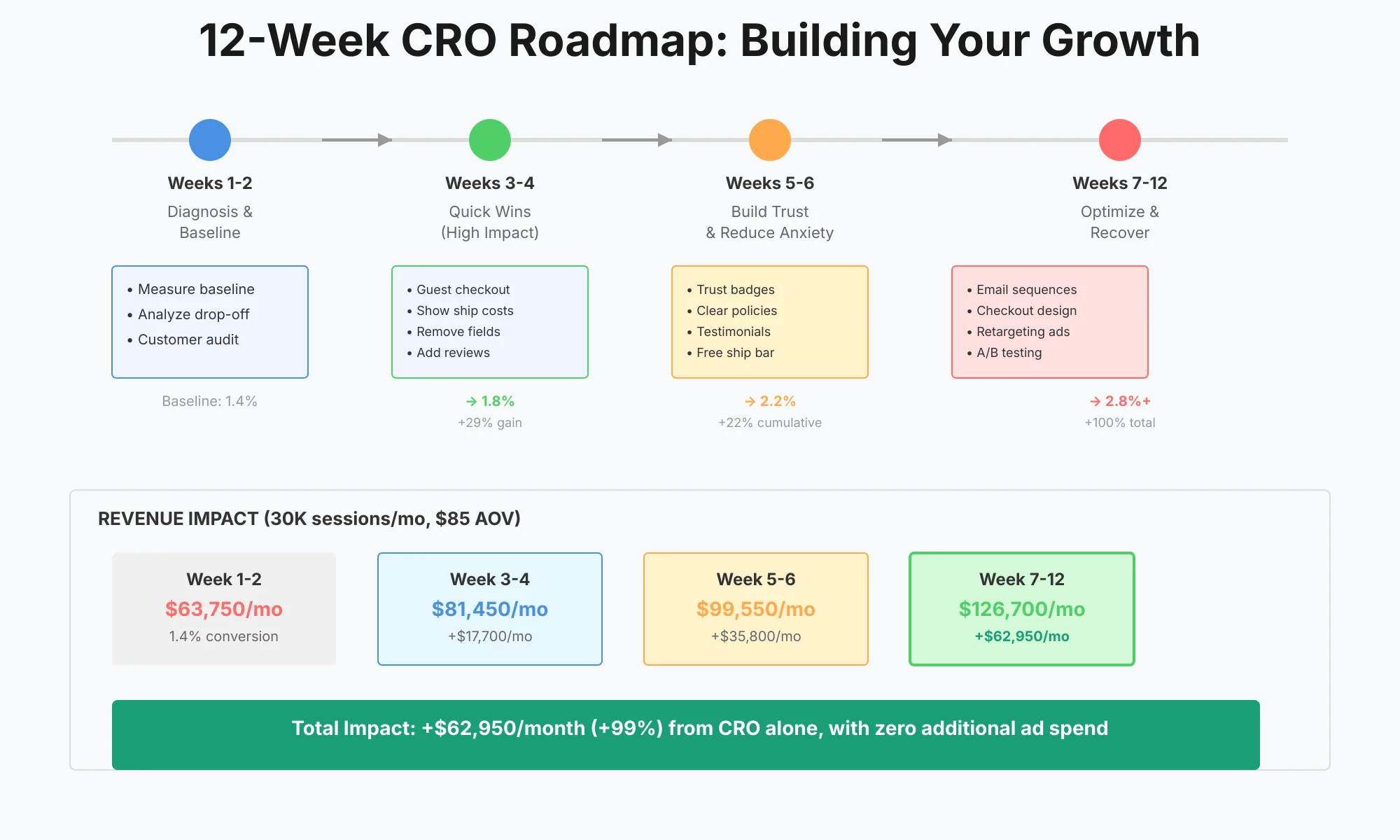
- Measure baseline conversion rate, cart abandonment, checkout completion
- Identify where customers drop off (use analytics + heatmaps)
- Interview 5-10 customers about friction points
- Audit competitors' checkout flows
Weeks 3-4: Quick Wins (Highest Impact, Lowest Effort)
- Enable guest checkout (if not already enabled)
- Show shipping cost in cart before checkout
- Remove 2-3 unnecessary form fields
- Add prominent customer reviews on product pages
Expected Lift: 3-7%
Weeks 5-6: Trust Building
- Add trust badges (SSL, payment logos, reviews)
- Create a clear refund/returns policy page
- Feature customer testimonials on checkout
- Test free-shipping threshold
Expected Lift: 2-4%
Weeks 7-9: Checkout Optimization (with Checkout Extensibility)
- Move to one-page checkout (if using multi-page)
- Implement address auto-fill
- Add Shop Pay as default option
- Test BNPL (Klarna, Afterpay)
Expected Lift: 5-10%
Weeks 10-12: Recovery & AOV
- Launch abandoned cart email sequence (1hr, 24hr, 72hr)
- Set up retargeting ads for cart abandoners
- Test free-shipping progress bar
- Add frequently-bought-together on cart
Expected Lift: 10-15% on recovery, 8-12% AOV lift
Connecting to Your Broader Shopify Growth Strategy
CRO is the foundation of a profitable Shopify business. While the pillar page "The Shopify Growth Guide 2026" covers the full ecosystem, Spoke #3 focuses exclusively on converting the traffic you already have.
The relationship looks like this:
- Spoke #1 (AI Product Discovery) — Gets you discovered by ChatGPT & Google
- Spoke #2 (TikTok Shop) — Brings impulse shoppers to your store
- Spoke #3 (CRO) ← YOU ARE HERE — Converts those visitors into customers
- Spoke #4+ (Retention, Email, etc.) — Turns buyers into repeat customers
Each spoke multiplies the impact of the previous one. A 50% improvement in CRO means every visitor from Spoke #1 and Spoke #2 is worth 50% more revenue.
Frequently Asked Questions
Q: What's a good conversion rate for my store?
A: The average Shopify store converts at 1.4%. Anything above 3.2% puts you in the top 20%. Industry benchmarks vary: beauty/fashion typically 2-3%, electronics 1-2%, home/garden 0.8-1.5%.
Q: How long until I see results from CRO?
A: Quick wins (removing form fields, enabling guest checkout) show results in 1-2 weeks. Larger changes (checkout redesign, email recovery) take 4-8 weeks to compound. Plan for a 12-week CRO roadmap.
Q: Should I A/B test everything?
A: No. Test high-impact changes (checkout flow, trust signals, payment options). Don't test low-impact changes (button colors, micro-copy). Use the data from 70,000+ experiments to make evidence-based decisions first.
Q: What's more important: getting more traffic or converting better?
A: Converting better. 100 visitors at 5% conversion = 5 customers. 1,000 visitors at 1% conversion = 10 customers. But the first scenario is cheaper to achieve and more defensible long-term.
Q: Can CRO alone replace paid advertising?
A: No. CRO multiplies the effect of traffic. The best stores do both: drive quality traffic (through ads, content, organic) and convert at high rates (through CRO). CRO isn't a substitute for traffic generation; it's the foundation that makes traffic profitable.
Q: How do I know if my CRO changes actually worked?
A: Run A/B tests for at least 2 weeks (ideally 4 weeks) to account for daily/weekly traffic variations. Use statistical significance calculators to confirm the result is real, not random variation.
This guide reflects 2026 CRO realities based on Baymard Institute research, data from 70,000+ A/B test experiments, and Shopify's own platform benchmarks.